
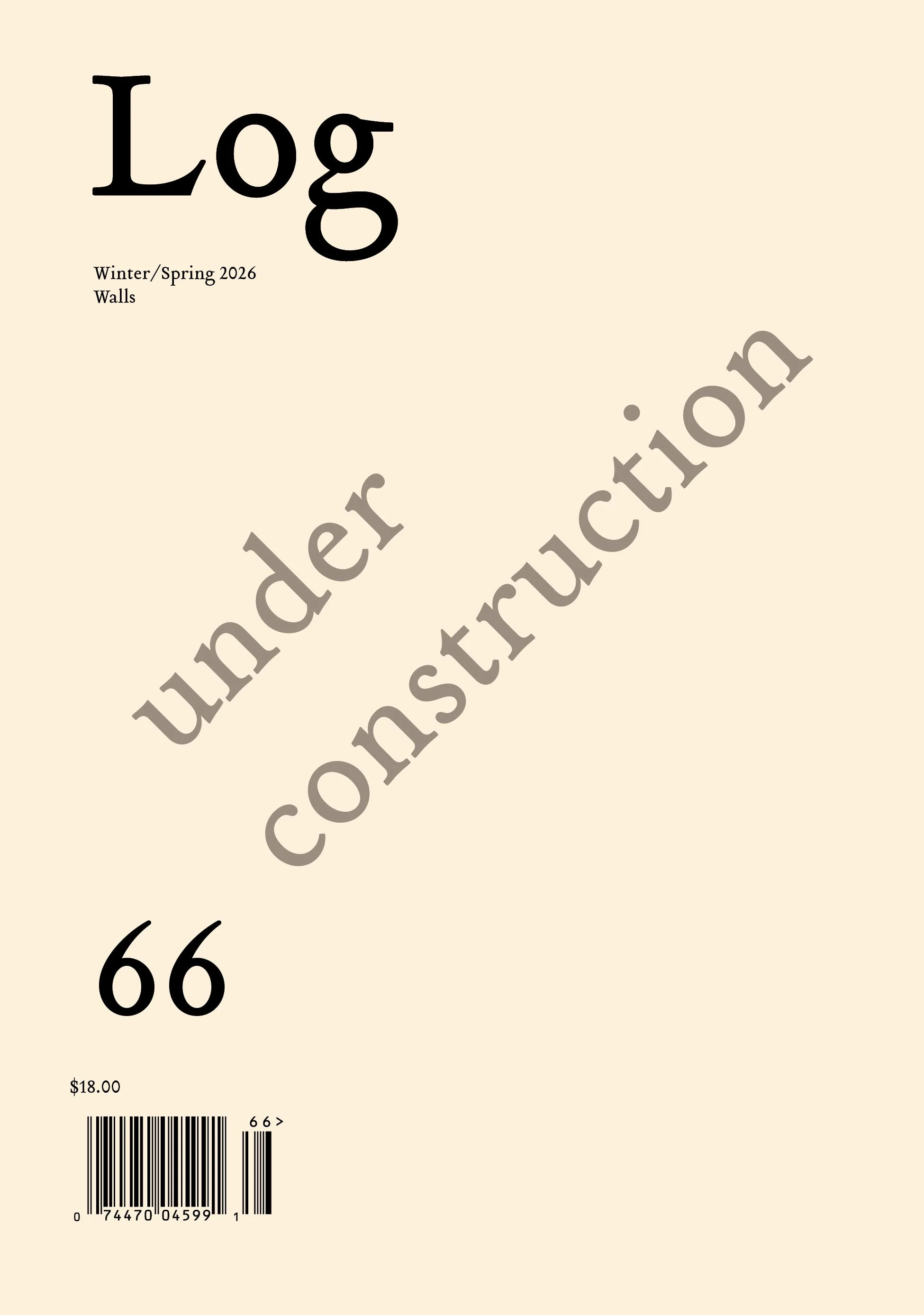
Log 66: Walls
Winter/spring 2026
Walls is currently under construction.
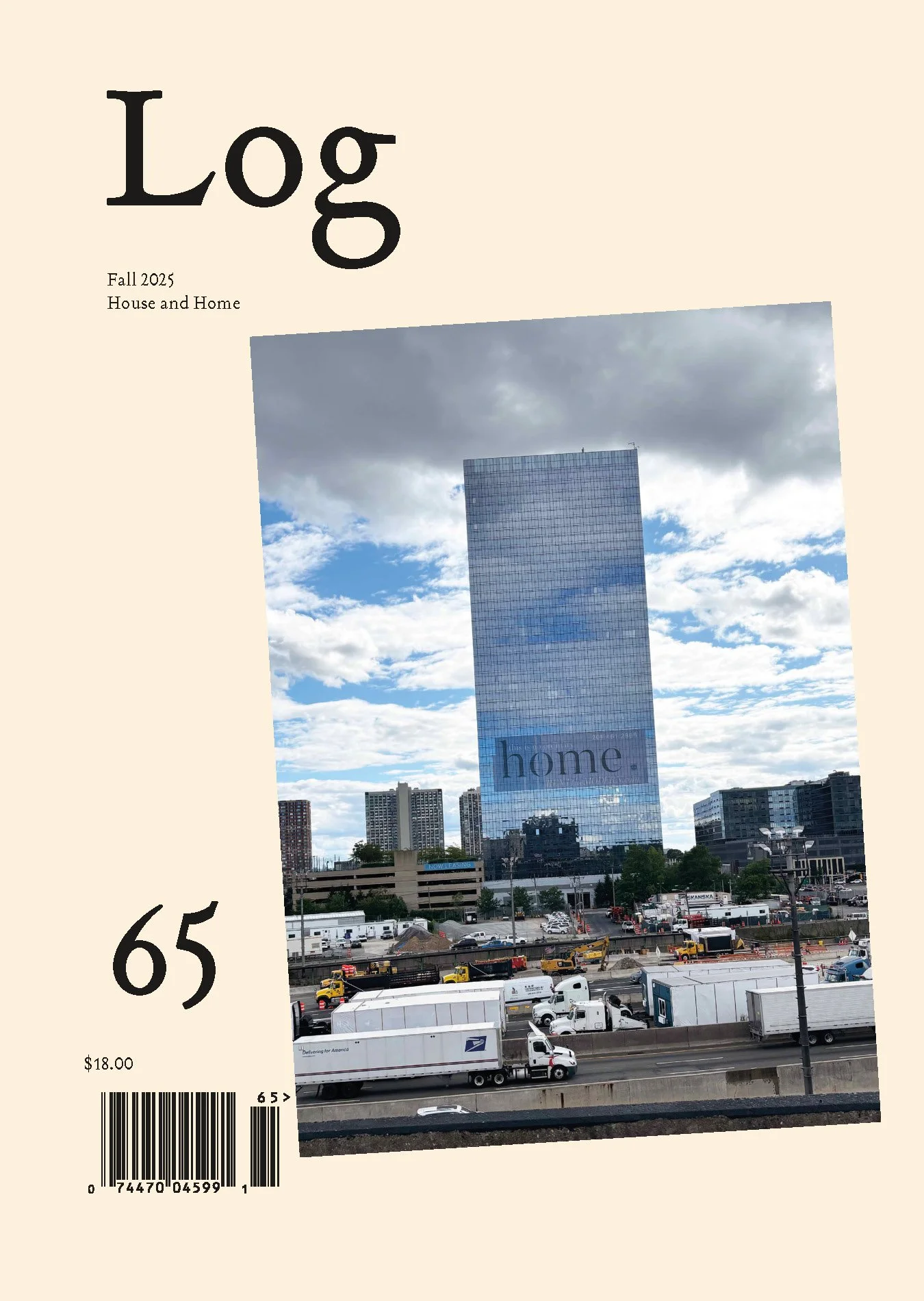
Log 65: House and Home
Fall 2025
Considering the many questions of how we live today, Log 65: House and Home asks: Where are we at home? What makes a house a home? Does the process of building ever cease, or does it become the activity of dwelling?
The issue features ten novel residential projects – both proposed and built – in full color, with accompanying texts by Daisy Ames, Peder Anker and Mitchell Joachim, Preston Scott Cohen, Thomas Daniell, Joe Day, Jon Lott, Mónica Ponce de León, Maria Alessandra Segantini, Kazuyo Sejima, and Bryan Young and Noah Marciniak. Not to be excluded, the “Average American House” converses with “Theoretical Discourse” in a dialogue stitched together by Taylor Dover. Building on the tension between developers and dwellers, Pier Vittorio Aureli and Maria Shéréhazade Giudici, Jolanda Devalle, Maya Freeman, and Alicia Pozniak speculate on how the market affects housing while Eric Höweler studies the spatial interplay of work and home. Architect Benedetta Tagliabue discusses how to evoke the feeling of home in public spaces, as do developers Rodrigo Rivero Borrell and Chris Murphy. Hilary Sample, Nahyun Hwang and David Eugin Moon tend to the domestic labor that goes into keeping house. Andrew Witt traces how the introduction of electricity animated the house while Jordan Hicks and Emanuele Coccia watch the ways houses are renovated and homes are redefined both on television and through laws. Excerpts from Frederick Kiesler’s Magic Architecture, Mark Jarzombek and Vikramaditya Prakash’s test of a Reyner Banham proposal, and Sylvia Lavin’s remembrance of Frank O. Gehry all look back on how architects have associated houses with societies, and Fernanda Canales looks ahead to the ways architects could invent places not just for living but for living together.
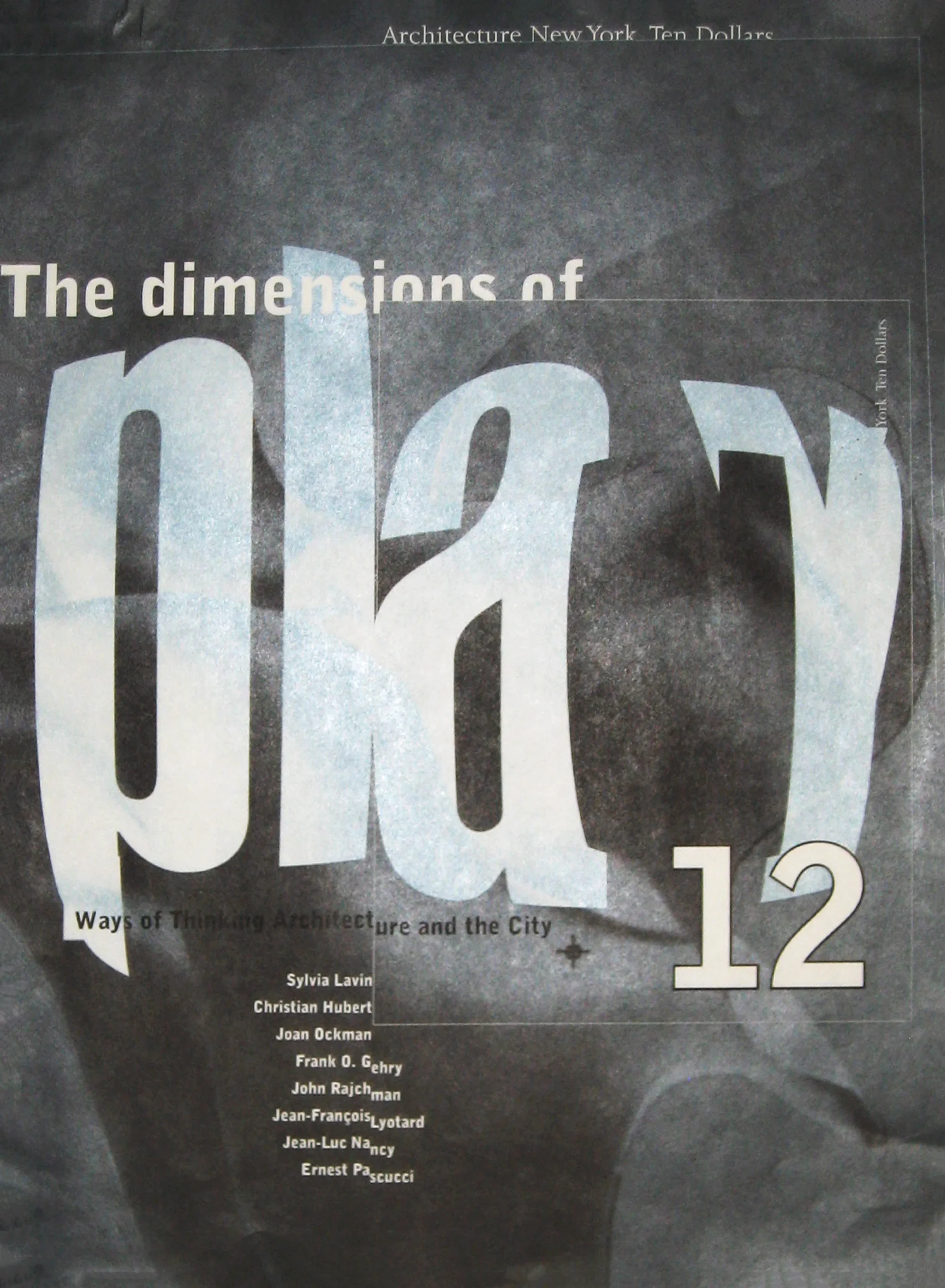
Remembering frank gehry
Frank Gehry was not a writer. But he liked to talk. In his honor, you can read Cynthia Davidson’s interview with him in ANY 12: The Dimensions of Play (1995), as well as Anna Neimark’s Log 64 essay on Gehry Partners’ recently completed Veterans Administration housing in Los Angeles.
Frank may be gone, but his voice and work live on.
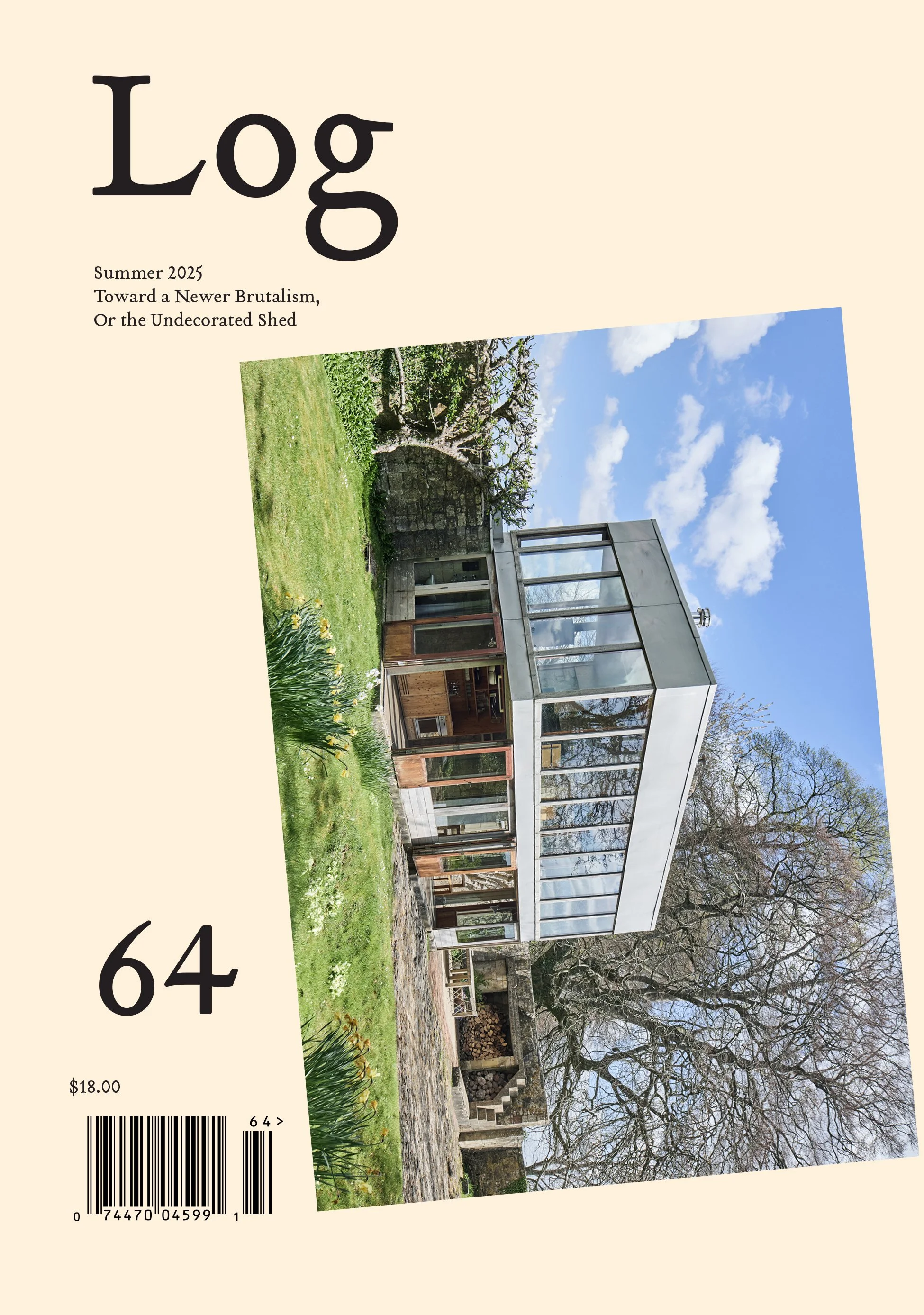
Log 64: Toward a Newer Brutalism,
Or the undecorated shed
summer 2025
As guest editor Emmett Zeifman wrote in his prompt for Toward a Newer Brutalism, or the Undecorated Shed, “Log 64 appropriates New Brutalism as a found theory of architecture that looks like exactly what it is made of.” To wit, Matthew Au, David Eskenazi, Mira Henry, Mireia Luzárraga and Débora Mesa discuss the assembly of materials, while material flammability is the concern of Dan Spiegel and Megumi Aihara. Clark Thenhaus manipulates 3D printed concrete, Zak Garone Leazer and Fernando Garrido Carreras interrogate stone, Salmaan Craig addresses the properties of heat, and Andrea Machado Romero and Eric Kyle Cheung pose maintenance as a design question. The envelopes of heating and cooling plants are analyzed by Daniel Jacobs and Brittany Utting; Mohamed Sharif heralds SO – IL’s rejection of the double-loaded apartment building corridor; and Anna Neimark celebrates Gehry Associates return to a Brutalist architecture in homes for veterans in West Los Angeles. Housing is also the focus of pieces by both Albert Pope and Andrew Holder, at vastly different scales, while Vanessa Grossman revisits the Brutalist work, including a house, of João Batista Vilanova Artigas. Aaron Forrest, Adam Frampton, Jeannette Kuo, Ajay Manthripragada, Jesús Vassallo and Yasmin Vobis talk with Emmett Zeifman about their work; Mark Foster Gage and Todd Gannon exchange views on Brutalism today, and Mark Linder reconsiders Alison and Peter Smithson’s “brutal intelligence” and “vulgar sophistication.” Mingru Han assess Liu Jaikun’s Chinese Brutalism, Preston Scott Cohen makes an argument for isomorphism, Joe Day posits a brut nouveau, and Peter Eisenman asks who’s Brutalist today. Wes Jones probes the meaning of form follows function, MOS draws up an undecorated shed, Daria Moatazed-Keivani builds with students, and Cameron Rowland documents “public use.” In assembling these voices under the rubric of Newer Brutalism, Zeifman writes, “Naming something provokes debate over the definition of terms, sustaining critical discourse and advancing architecture toward a conscious relationship to its history, limits, and potentials.”

Rare art and architecture books for sale!
Anyone corporation abe books storefront
Hundreds of rare art and architecture books and periodicals were recently donated to the Anyone Corporation. This collection is now available on AbeBooks, with new titles added each week. The books range from the 19th to the 21st centuries and from the works and words of the modern architects to contemporary practitioners. The texts are in multiple languages and span various movements, from cubism to De Stijl, the Bauhaus to expressionism, postmodernism to deconstructivism.
Four Architectural Association Folios and three Archigram volumes are among the rarest offerings. There are multivolume tomes, such as an 1886 edition of John Ruskin’s The Stones of Venice, and bound volumes of periodicals including one of Architectural Record in 1910. Periodicals include AD, Artforum, Rassegna, Casabella, Domus, AV Monographs, and El Croquis, spanning from the 1950s to the early 2000s. The collection also includes exhibition catalogs and monographs on artists and architects such as Karl Lagerfeld, Sol Lewitt, Le Corbusier, Peter Eisenman, Toyo Ito, Kazuyo Sejima, and Louis Sullivan.
All proceeds support the programs of the Anyone Corporation, a 501(c)(3) nonprofit organization in New York.

Log 63
Winter/Spring 2025
In Log 63, poet Emily Stewart walks around Graz and thinks of “Doreen Massey’s notion of ‘throwntogetherness,’ a term she uses to gather the multifarious threads of what it means to think speculatively in space and time.” In a sense, this open issue of Log is an example of that throwntogetherness, with threads connecting ideas and voices, across time and space, on a range of concerns in and about architecture today.
From the new, forthcoming translation of Victor Hugo’s Notre-Dame de Paris, the chapter “This Will Kill That,” on the tension between the book and the building, plays against Cynthia Davidson’s synthesized report on three new books, three projects in Los Angeles, and an exhibition in New York. In Houston, Dora Epstein Jones reviews “The Sixth Sphere,” an exhibition that reflects architecture’s approach to ecology, while François Roche, recalling time in Bangkok, indicts academia for climate hypocrisy, and Casey Mack, in New York, investigates suspected greenwashing at Foster + Partners’ new Park Avenue skyscraper. In Tokyo, Kengo Kuma remembers his mentor Hiroshi Hara, while in Brooklyn, An Tairan remembers his, Kurt W. Forster. Wes Jones assesses what was lost in the Los Angeles fires, while Béatrice Grenier questions what was rebuilt in Paris after the Notre-Dame inferno. Lorenzo Degli Esposti proposes a localized canon for Milanese modernism, and David Buege evaluates the legacy of modernism in Thomas Phifer’s new art museum in Warsaw. Neil Levine revisits the postmodern turn via a 1963 debate between Norman Mailer and Vincent Scully, while Park Myers talks with curator Amber Esseiva about “Dear Mazie,” an exhibition in Virginia on a Black and queer modernist architect, and Ferda Kolatan contemplates modernist mythology in his review of the film The Brutalist.

Log 62
Fall 2024
The 184 pages of Log 62 present all new authors, including 15 South Americans in a special section guest edited by Brazilian architect and critic Jaime Solares Carmona. Called Far South, the section observes contemporary architecture and criticism in South America by a generation that Solares calls “equidistant from the modernist ethos of previous generations while also distancing itself from a more radical critical approach that leans toward an ‘anthropologization’ of architecture.”
Far South includes new English translations of seminal essays by architect and teacher Sérgio Ferro on brutalist architecture during the Brazilian dictatorship, and the late Argentine critic and theorist Marina Waisman’s incisive analysis of critical regionalism. Argentine-born Florencia Rodríguez, director of the 2025 Chicago Biennial, discusses the dispersion of discourse, and in Bolivia, Guido Alejo Mamani documents Indigenous avant-garde aesthetics. In Brazil, Frederico Costa and Solares unpack the box as an urban typology, and Mariana Wilderom compares what she calls the “everyday monumentality” of São Paulo and Medellín, Colombia. In Chile, Alejandra Celedón grapples with architectural autonomy and social responsibility in the work of Pezo von Ellrichshausen, Alejandro Aravena, and Smiljan Radic; Carlos Eduardo Binato de Castro and Suelen Camerin examine houses by Radic and Miguel Eyquem Astorga; and José Luis Uribe Ortiz considers the role of local materials in building throughout South America. In Colombia, Plan: B Arquitectos outlines an agenda for “re-activism.” And in Ecuador, Mariana Alves Barbosa maps the global reach of women architects through the Architecture Biennial of Quito.
Also in Log 62, Michael Speaks remembers cultural critic Fredric Jameson and his contribution to architecture theory; Fernanda Canales looks at the 19th- and early 20th-century Home Improvement Movement to challenge architecture to do more rather than less; Manuel Álvarez Diestro records the need for air conditioners around the world; and Lachlan Summers investigates the lifespan of concrete in the face of earthquakes in Mexico City.

Log 61
SUMMER 2024
From the Norwegian seaside to the Ethiopian highlands; from the Bavarian Forest to the Taiwanese coast; from Venice to the Las Vegas Venetian, Log 61 travels in pursuit of architecture. In this open summer issue, Christopher Pierce visits cabins designed by Kastler Skjeseth Architects, and Motuma Tulu drives across southern Ethiopia to document informal architecture; Tim Altenhof rides along with architect Peter Haimerl to see his unique housing and restoration work, while Thomas Daniell wrestles with the appendages of RUR Architecture’s Kaohsiung Port Terminal; and in Venice, Lina Malfona contemplates Tadao Ando’s exhibition design for painter Zeng Fanzhi, while behind the Venetian, Cameron Wu assesses the geometric problems in Populous’s Sphere. Jimenez Lai checks out the architectural follies at Coachella, and Ben Fehrman-Lee sees the Frederick Kiesler exhibition in
New York.
Log 61 also includes the speculative travels of the mind, with Iman Ansari advocating a program of action, Kristine Chung investigating parasitic cell towers, and Andrew Witt digging into the avant-garde proposals of Doug Michels and Ant Farm. The issue is peppered with 10 short observations, which range from book and exhibition reviews to 5G infrastructure and the ever-changing streetscape, and then concludes with a trio of endings: Todd Gannon marks the end of an era with the passing of José Oubrerie, André Patrão questions what it means to speak of the “end” of architecture, and Justin Beal imagines an architecture that forestalls the “end of the world.” From these endings, new journeys begin.
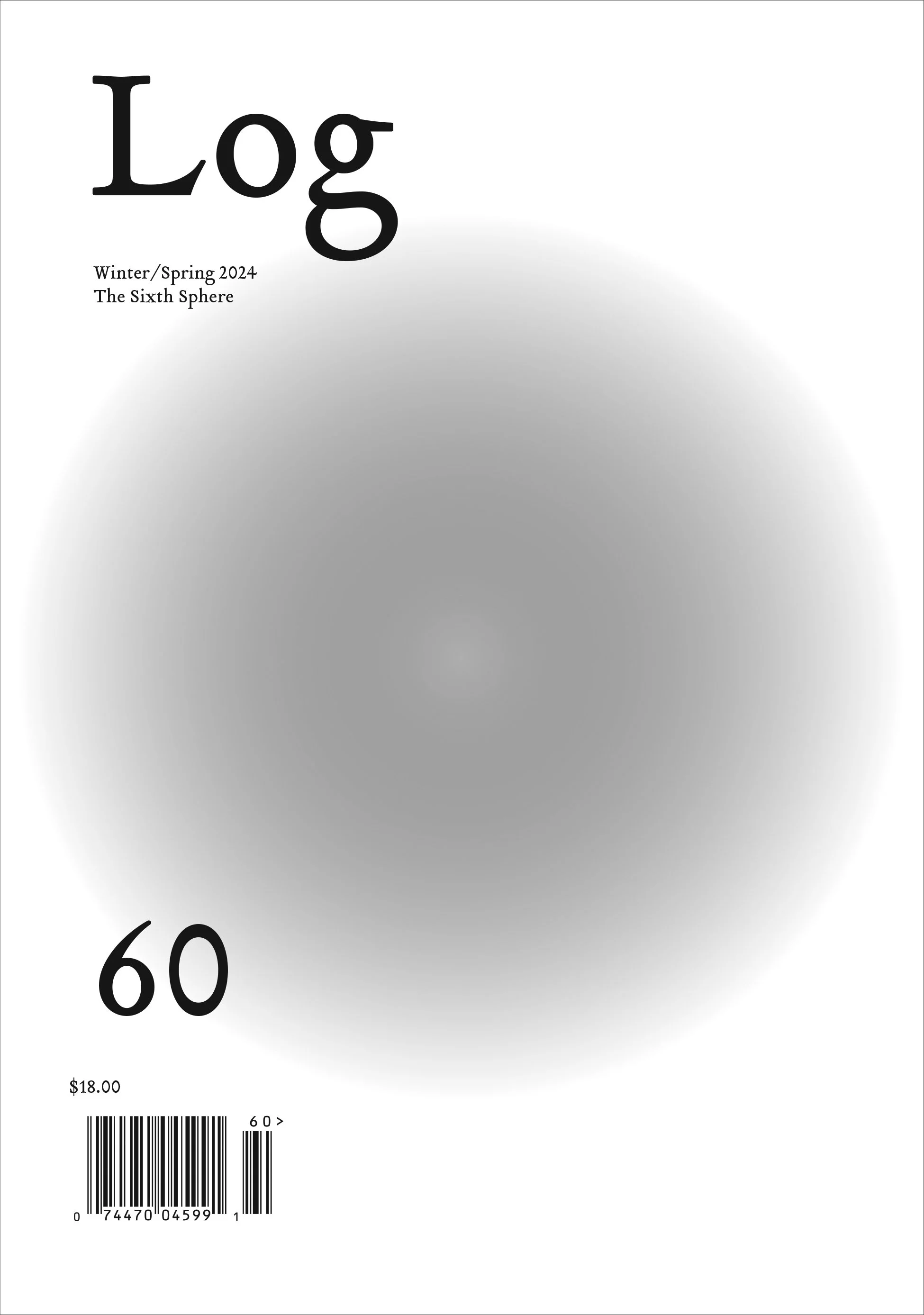
Log 60: The Sixth Sphere
Winter/Spring 2024
“The architecture we inhabit, the urban systems we rely on, and the landscapes we transform are all part of the technosphere,” write Albert Pope and Brittany Utting, guest editors of Log 60: The Sixth Sphere. For them, the sixth sphere is the technosphere, an emergent man-made system entangled with the Earth’s five natural spheres: the atmosphere, hydrosphere, biosphere, cryosphere, and lithosphere. “Taken as a whole, the technosphere includes our feedlots and sewer systems, factories and housing, tarmacs and croplands, and every modification we have made to the ground, the glaciers, the sea, the air, and the biosphere. It is a vast and often banal landscape. . . . Almost everything we do – prepare a meal, buy a shirt, message a colleague, fill a prescription, take a bath – we do through the technosphere.”
Log 60, a 208-page thematic issue, explores the technosphere as “a planetary enmeshment of bodies, environments, and technologies” by examining the Earth’s natural spheres through the lenses of architecture, science, and philosophy. Geologist Peter K. Haff defines the technosphere; architect Rafael Beneytez-Duran, philosopher Emanuele Coccia, and historian Ingrid Halland each consider how we occupy and breathe the atmosphere; architects Alexandra Arènes, Daniel Jacobs, Brittany Utting, Lydia Kallipoliti, Andreas Theodoridis, and Neyran Turan take on the scope of the biosphere; architects Margarita Jover, Marina Tabassum, and Maggie Tsang wade through the history and challenges of the hydrosphere; anthropologist Dominic Boyer, landscape architect Leena Cho, and architects Billy Fleming, Joyce Hsiang, and Bimal Mendis take stock of the possible futures of the cryosphere; and climate researcher Holly Jean Buck, architects Rania Ghosn, Ang Li, and Marina Otero Verzier each dig into the possibilities in the lithosphere. As the guest editors write: “Log 60 positions the technosphere not only as a geophysical condition to understand and critique but also as a collective site in which to construct alternative social, technical, and environmental futures.”

Log 59
Fall 2023
To mark Log’s 20 years of observing architecture and the contemporary city, former guest editors and current editorial protagonists were invited to interview someone whose work resonates with their current thinking or concerns, or even with what keeps them up at night. The conversations they initiated range from designing with AI to AI’s possible future consciousness; from natural French wine to Indigenous Mexican textiles; from building architecture to theorizing architecture; from corruption in the building industry to untold histories. Literary critic Caroline Levine calls for activism; urbanist Milton S.F. Curry says it’s a time for manifestos; and artist Ursula Biemann brings our relationship to a changing Earth System into sharper view.
The ideas and opinions of the 55 voices in Log 59 both push against and coincide with each other. But they all testify to the changes in architecture and culture since Log was launched in September 2003.

Architecture and Abstraction
Pier Vittorio Aureli
In this theoretical study of abstraction in architecture – the first of its kind – Pier Vittorio Aureli argues for a reconsideration of abstraction, its meanings, and its sources. Although architects have typically interpreted abstraction in formal terms – the purposeful reduction of the complexities of design to its essentials – Aureli shows that abstraction instead arises from the material conditions of building production. In a lively study informed by Walter Benjamin, Karl Marx, Alfred Sohn-Rethel, and other social theorists, Architecture and Abstraction presents abstraction in architecture not as an aesthetic tendency but as a movement that arises from modern divisions of labor and consequent social asymmetries.
These divisions were anticipated by the architecture of antiquity, which established a distinction between manual and intellectual labor, and placed the former in service to the latter. Further abstractions arose as geometry, used for measuring territories, became the intermediary between land and money and eventually produced the logic of the grid. In our own time, architectural abstraction serves the logic of capitalism and embraces the premise that all things can be exchanged – even experience itself is a commodity. To resist this turn, Aureli seeks a critique of architecture that begins not by scaling philosophical heights, but by standing at the ground level of material practice.
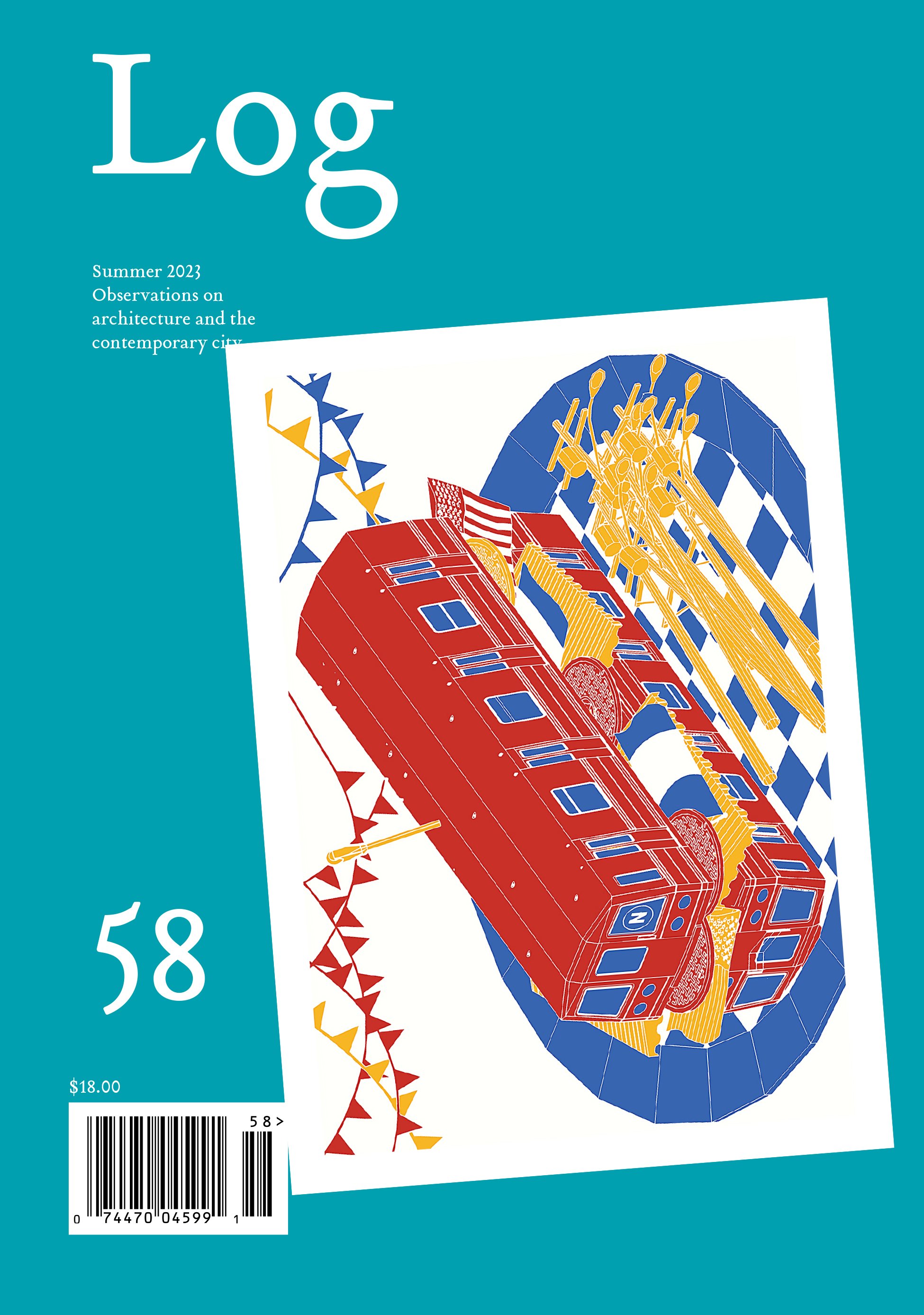
Log 58
Summer 2023
From building renovations to drawing trees and planting forests; AI and air flow; exhibitions of architecture and architecture for exhibitions, Log 58 brings together articles by 18 authors, both new and established. In this 160-page open issue, Emmett Zeifman codifies “Five Points” in the work of Lacaton & Vassal and Lisa Hsieh finds kawaii qualities in Hideyuki Nakayama’s designs. Harish Krishnamoorthy explores two politicized Hong Kong museums while Cynthia Davidson studies Studio Gang’s addition to the American Museum of Natural History in New York. Mario Carpo considers the generative capacity of precedents in AI; Ian Erickson, the form-finding potential of a digital breeze; and Phillip Denny, the details of a drawing by Michelle JaJa Chang. Shiila Infriccioli recounts the aftermath of a storm in Italy, Waiko Waida storyboards an early modern movement in Japan, and Norihisa Kawashima renovates an office building.
Then there are the exhibitions: Donald Bates, Courtney Coffman, and Thomas Daniell each assess the good, the bad, and the socializing at the 18th Venice Architecture Biennale. Christian Nakarado reviews “Confronting Carbon Form” at The Cooper Union in New York, and Patrick Templeton visits “Transformación urbana: Sordo Madaleno Arquitectos” in Mexico City.
Log 58 also pays tribute to three important, recently lost voices, two of them with new translations: Arata Isozaki on Metabolism, and Bruno Latour on modernism; as well as Craig Hodgetts’s remembrance of Los Angeles visionary architect Robert Mangurian.

Architecture’s Theory
Catherine Ingraham
From poststructuralism and deconstruction to current theories of technology and nature, critical theory has long been closely aligned with architecture. In turn, architecture as a thinking profession materializes theory in the form of built work that always carries symbolic loads. In this collection of essays, Catherine Ingraham studies the complex connectivity between architecture's discipline and practice and theories of philosophy, art, literature, history, and politics. She argues that there can be no architecture without theory.
Whether considering architecture's relationship to biomodernity or exploring the ways in which contemporary artists and designers engage in figural play, Ingraham offers provocative interpretations that enhance our understanding of both critical theory and architectural practice today. Along the way, she engages with a wide range of contemporary theorists, including Giorgio Agamben, Judith Butler, Jacques Derrida, Graham Harman, and Timothy Morton, considering buildings around the world, including the Palace of Culture in Warsaw, the Viceroy's House complex in New Delhi, Mack Scogin and Merrill Elam's Wolfsburg Science Center project in Germany, and the Superdome in New Orleans. Approaching its subject matter from multiple angles, Architecture's Theory shows how architecture's theoretical and artifactual practices have a unique power to alter culture.

Log 57
Winter/Spring 2023
“Calls for more Blackness in architecture schools can be simplistic,” writes architect Darell Wayne Fields, guest editor of Log 57. Well-meaning equity and inclusion programs often simply “associate the mere presence of Black bodies with institutional change.” In Log 57, a 208-page thematic issue titled Black is . . . an’ Black ain’t . . ., 29 authors explore the complexities of Blackness as it relates to aesthetics and architectural pedagogy. As Fields notes, “In calling for more Blackness, I, for one, am calling for more Black methodology. An inherent characteristic of [which] is a measurement of difference.”
To that end, Log 57 gathers essays and reflections on architectural pedagogies, both in academia and in practice, by Sean Canty, Michelle JaJa Chang, Ajay Manthripragada, and Mónica Ponce de León, among others. Projects by young designers for whom methodological concepts of Black Signification and bricolage are central are presented in a four-color section, and built works and a preservation effort channel difference as a generative force in real-world communities. “This work demonstrates what is possible when methodological change is real,” writes Fields. “Real change, like Blackness, makes us nervous. Black difference, however, is revolutionary.”
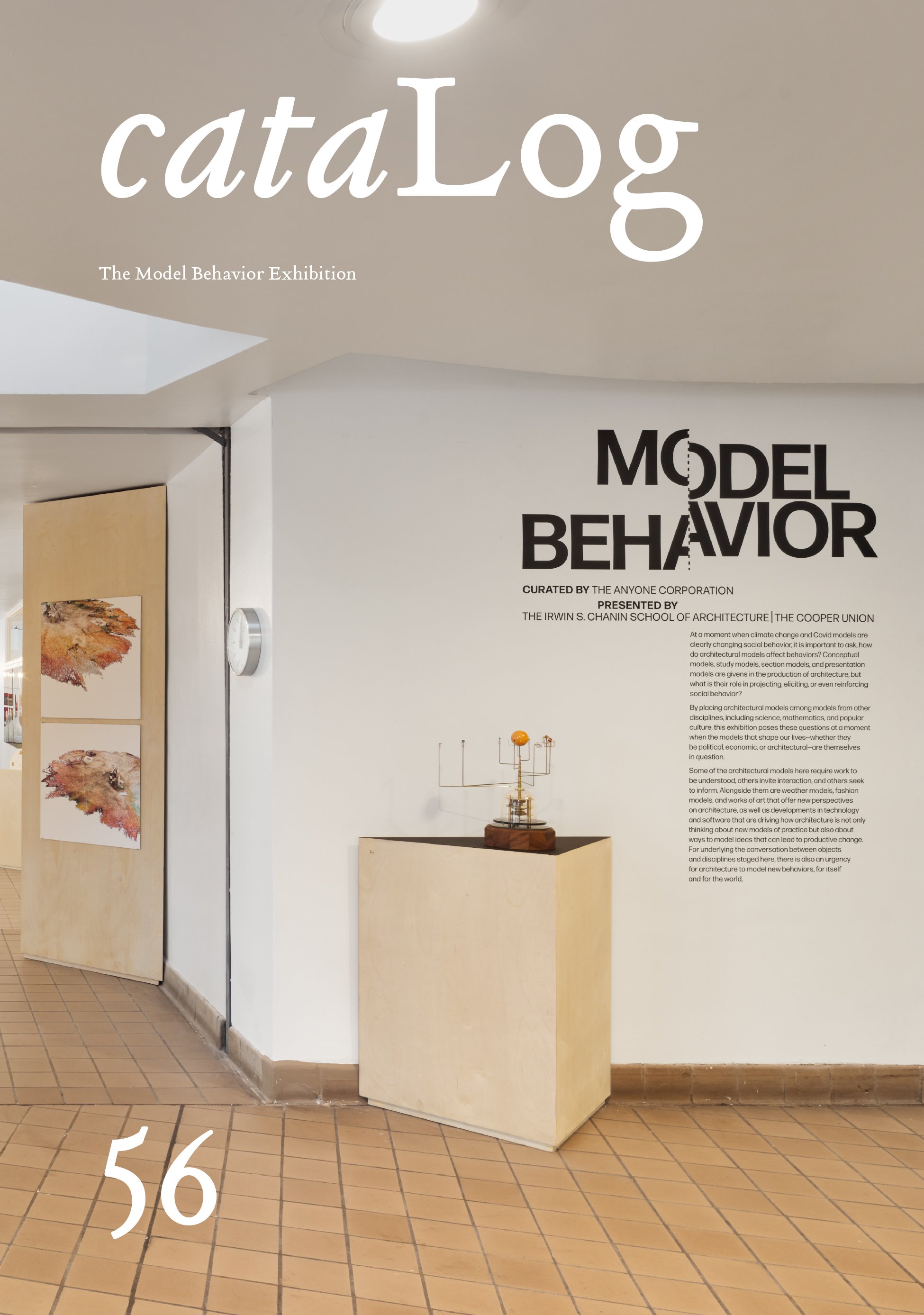
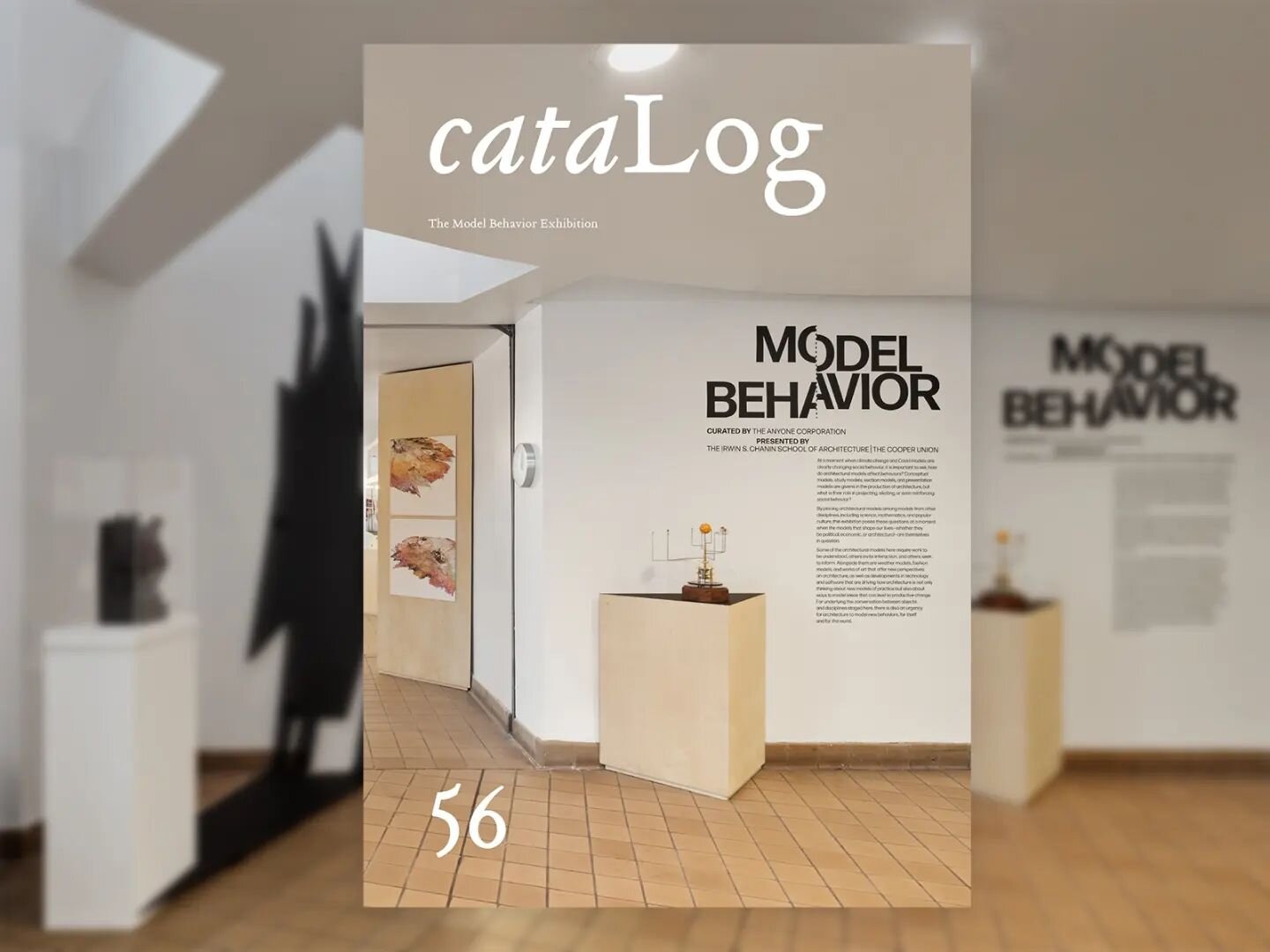
LOG 56: THE MODEL BEHAVIOR EXHIBITION
Fall 2022
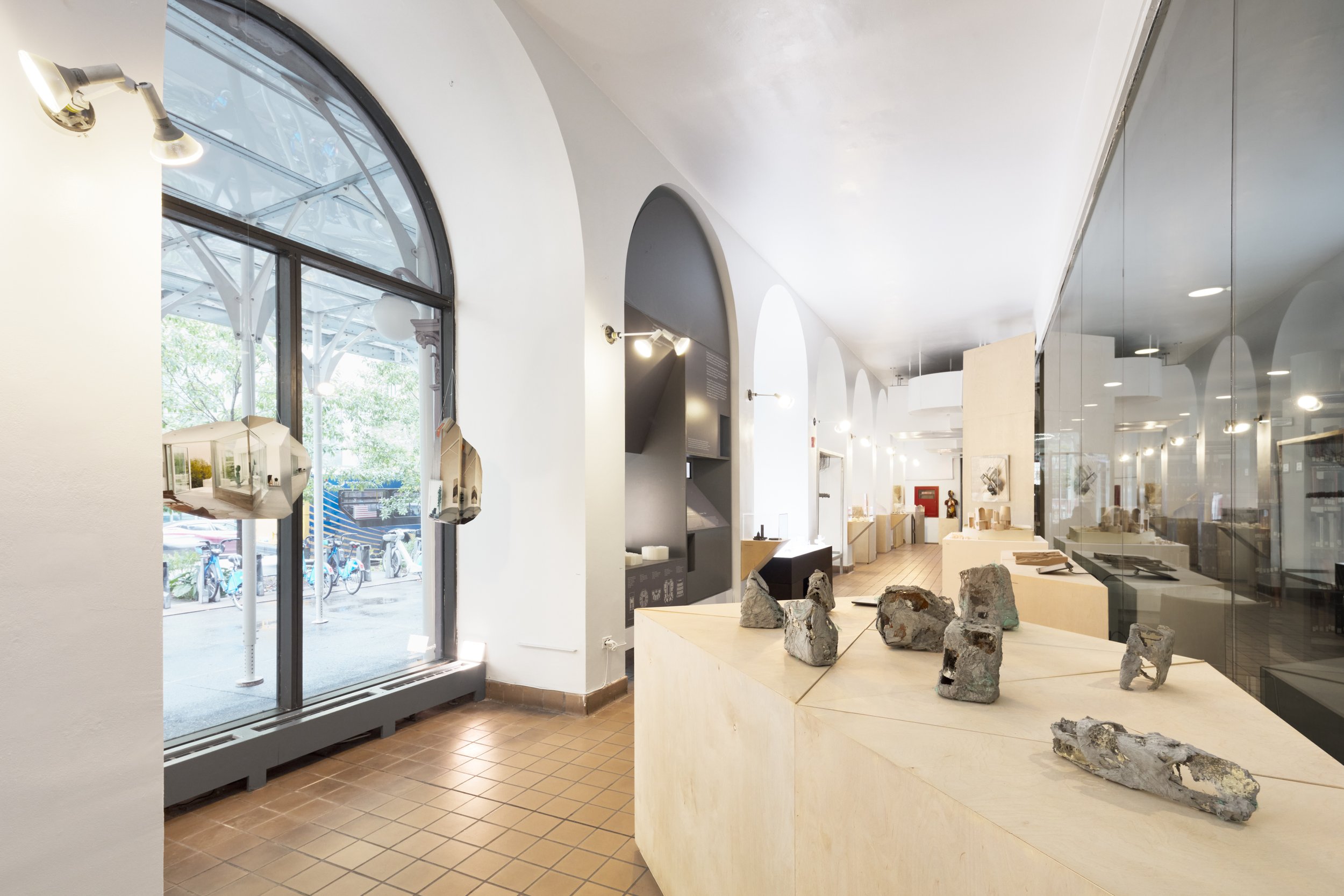
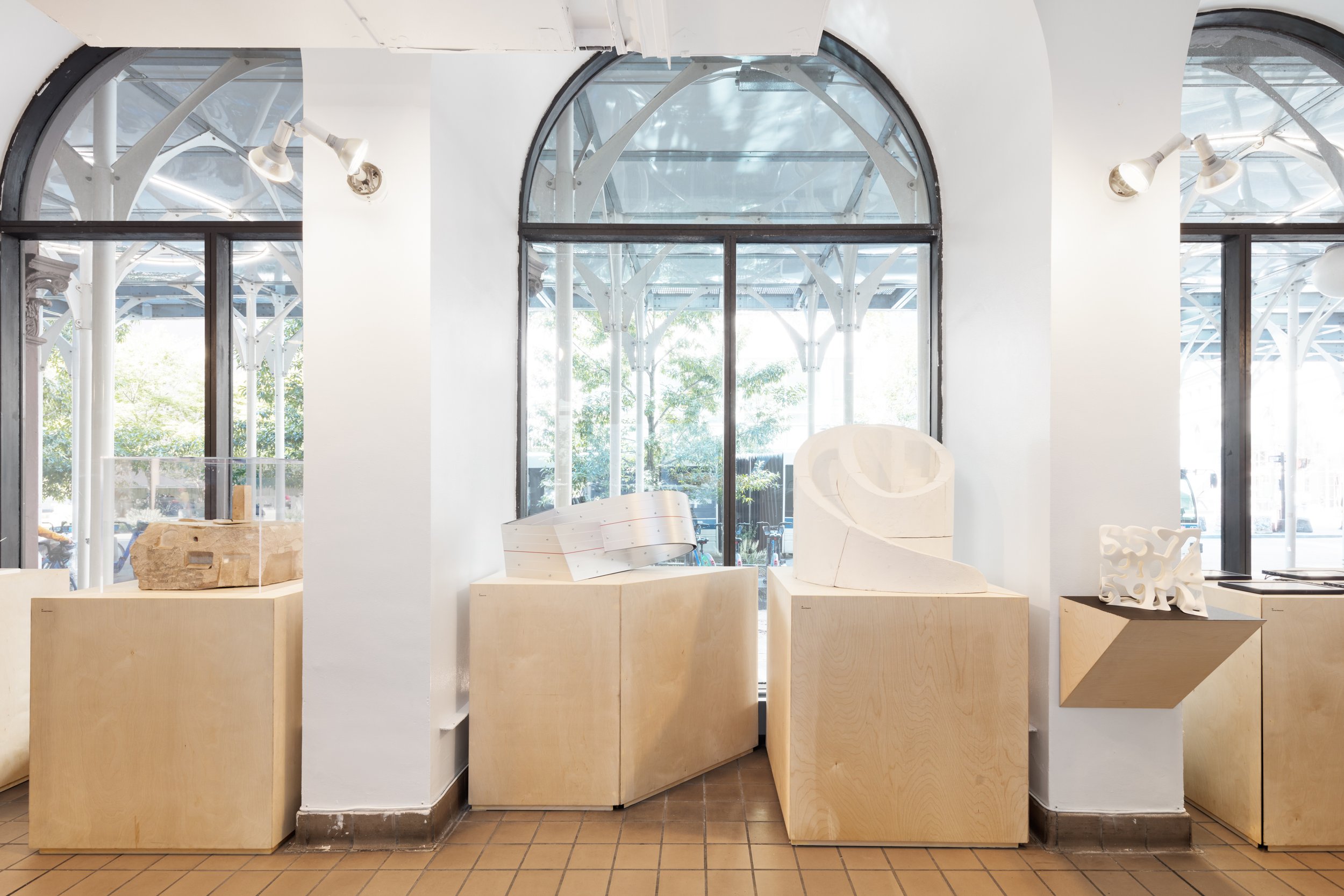
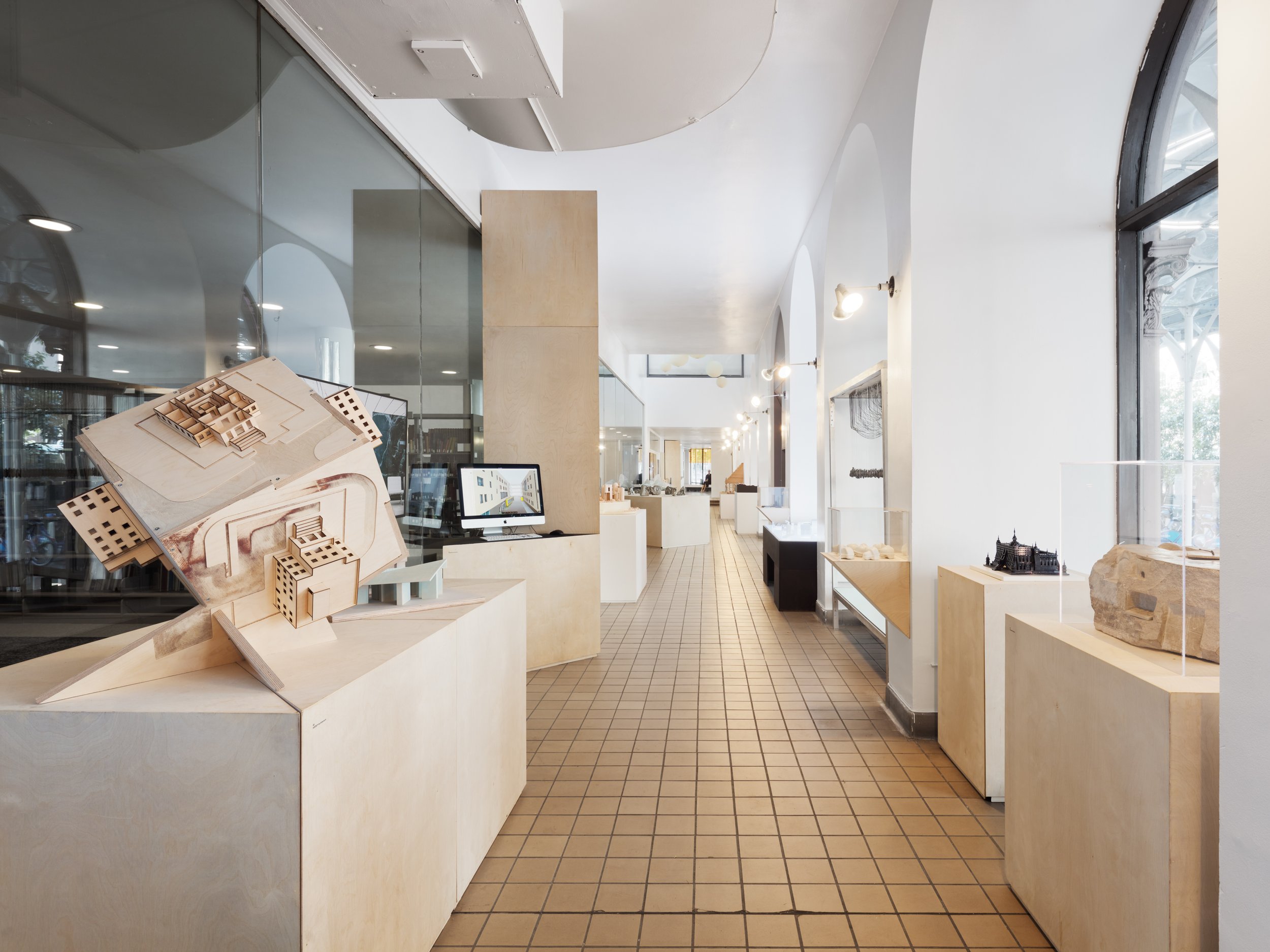
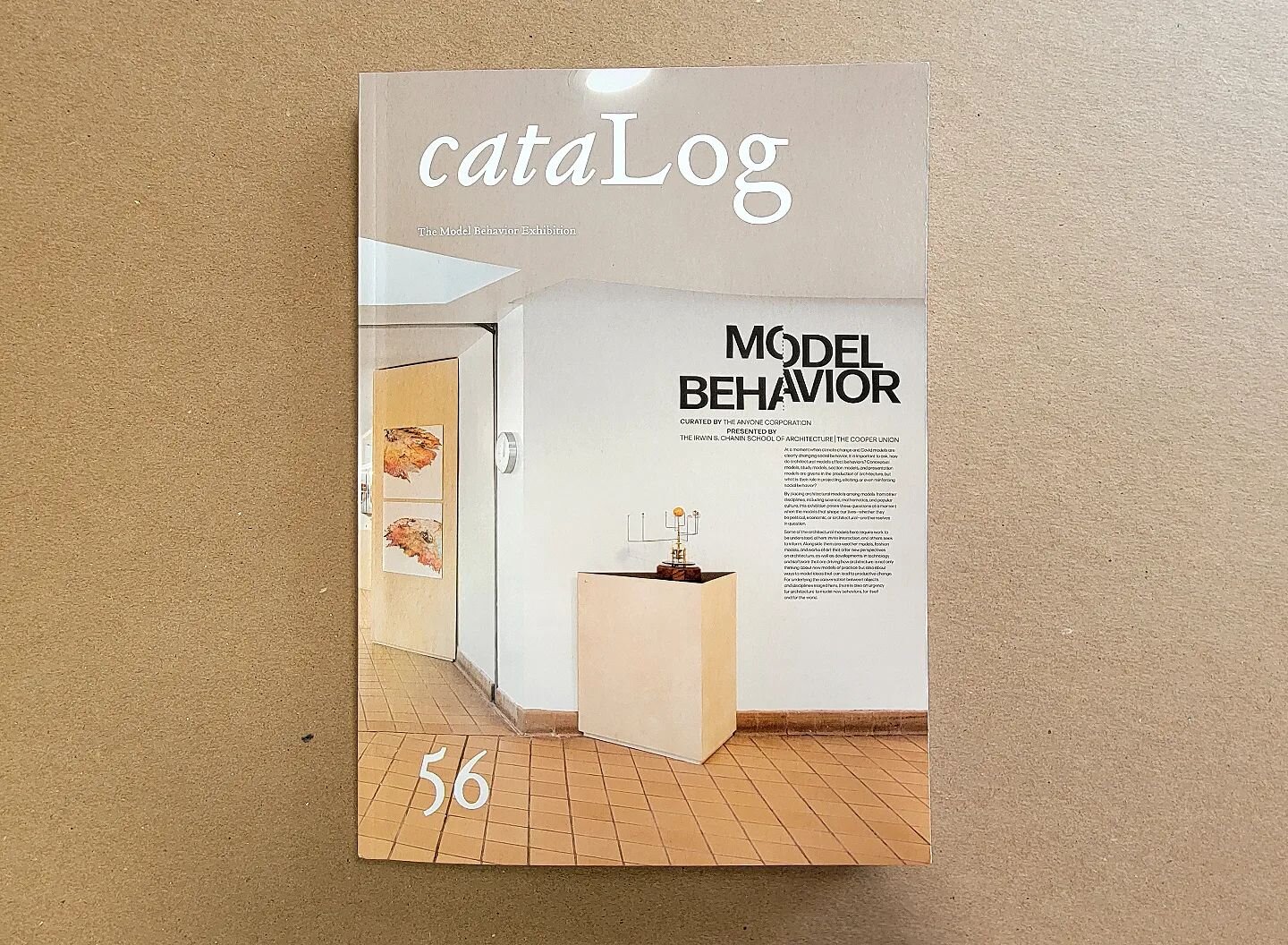
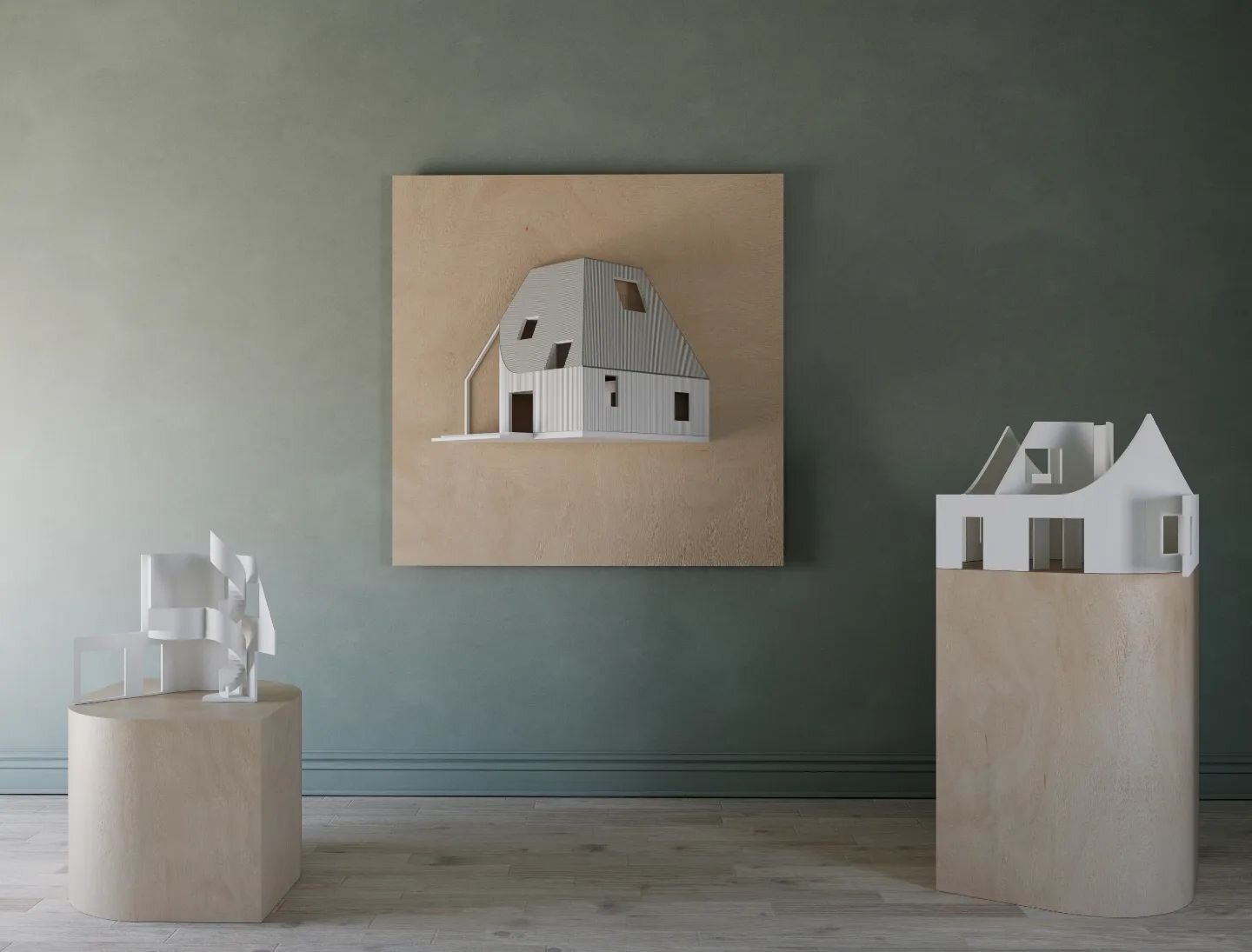
This special issue is the cataLog for “Model Behavior,” a group exhibition of models, architectural and otherwise, curated by the Anyone Corporation and presented by The Irwin S. Chanin School of Architecture at The Cooper Union, in New York City. The exhibition, which ran October 4–November 18, 2022, questioned the role of the model in projecting or eliciting social behavior. In addition to documenting the 55 exhibited works with four-color images and project descriptions, the 160-page cataLog includes essays by curator Cynthia Davidson; by architecture theorists Jörg H. Gleiter, Kiel Moe, and Christophe Van Gerrewey; and by art historian Annabel Jane Wharton.
Tour the Digital Twin
The “Model Behavior” digital twin was developed by Farzin Lotfi-Jam. Click here to view in a new tab.
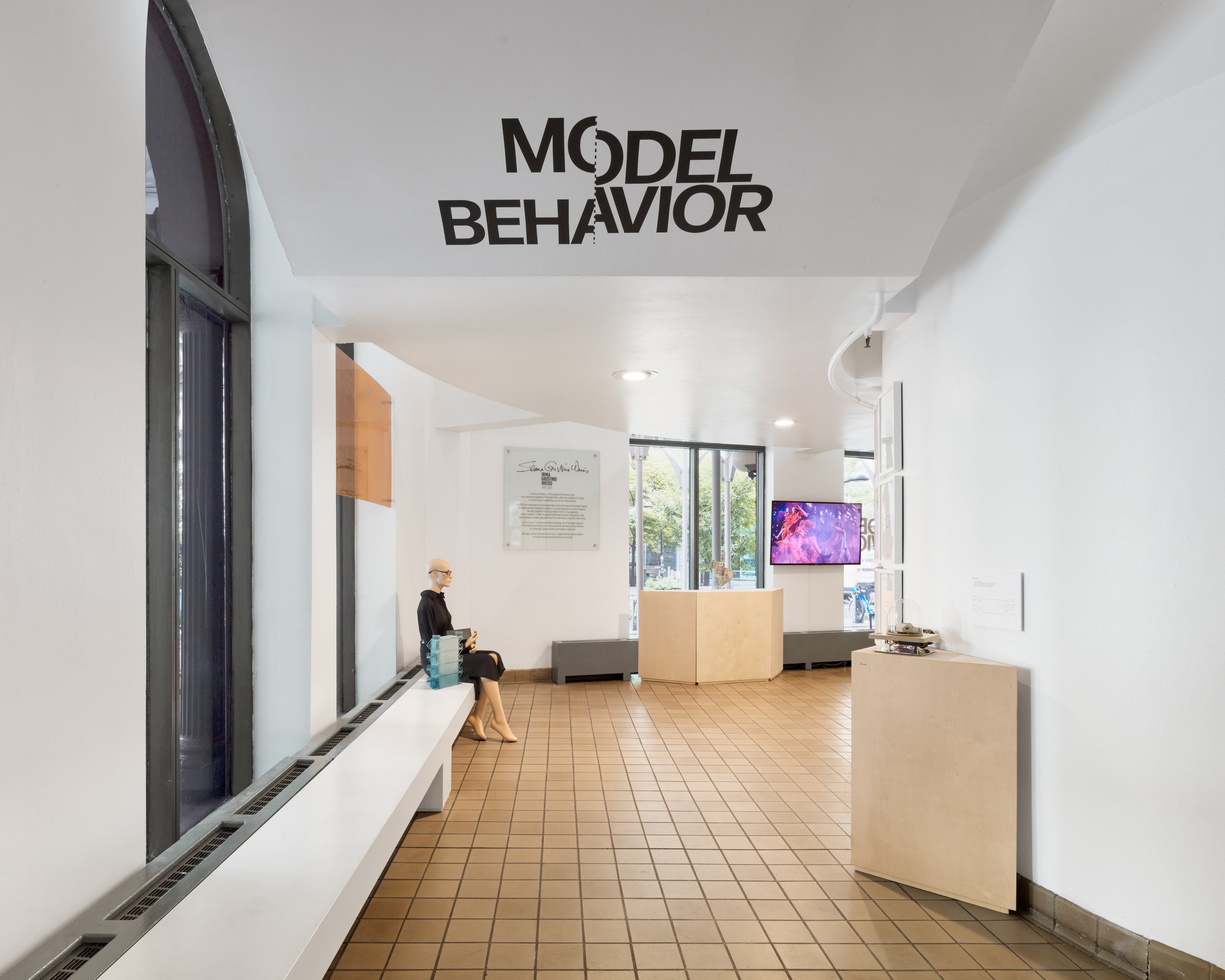
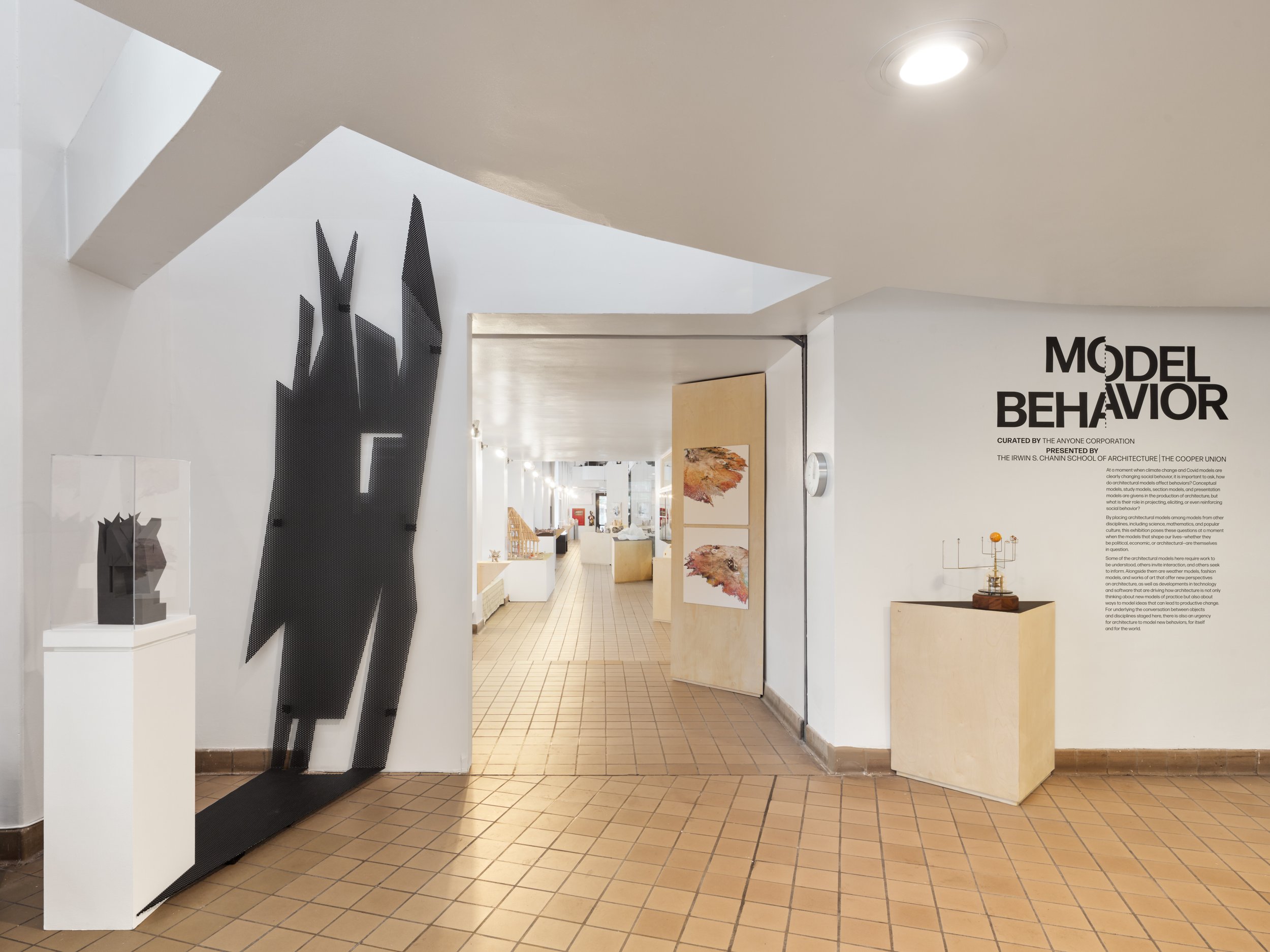
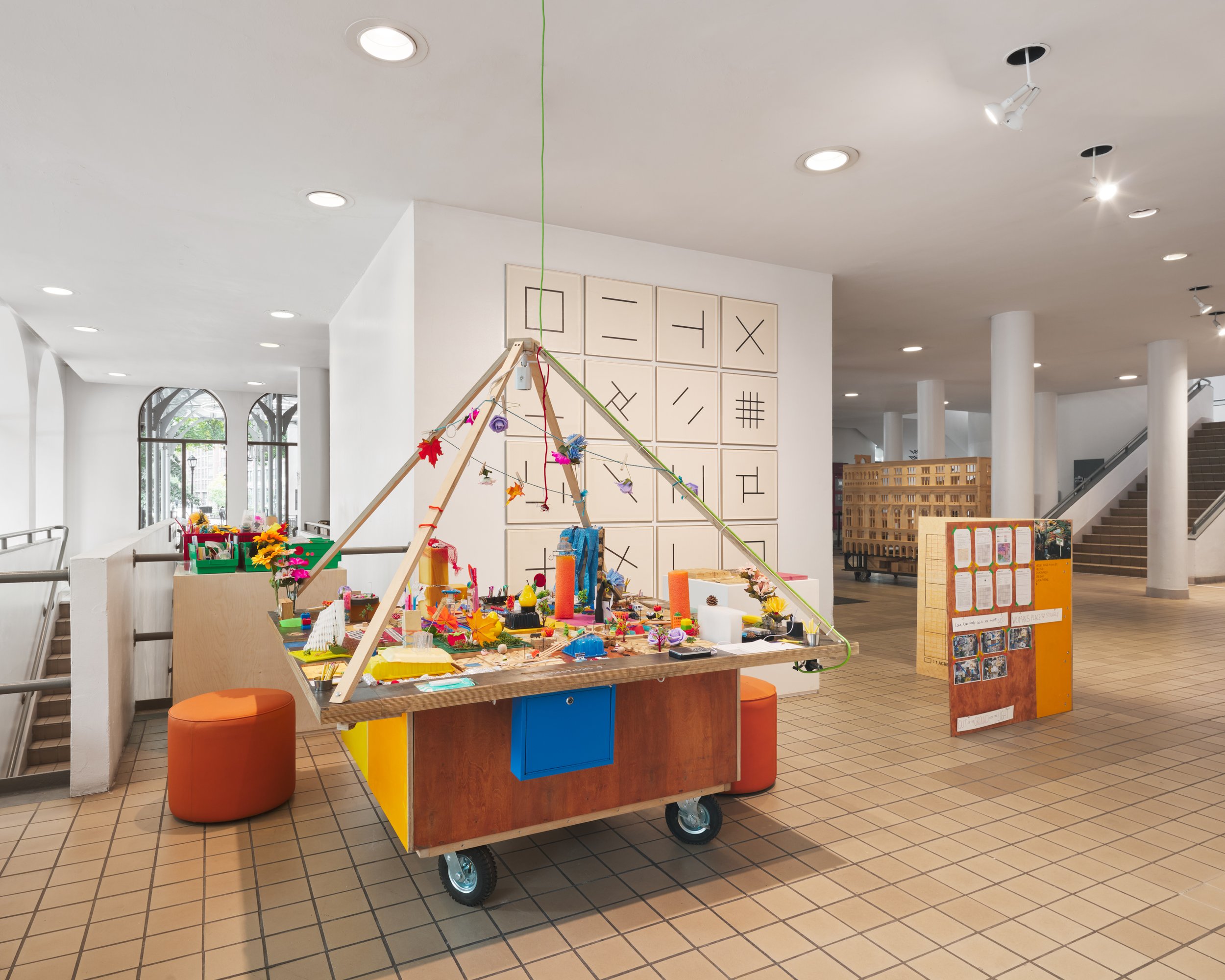
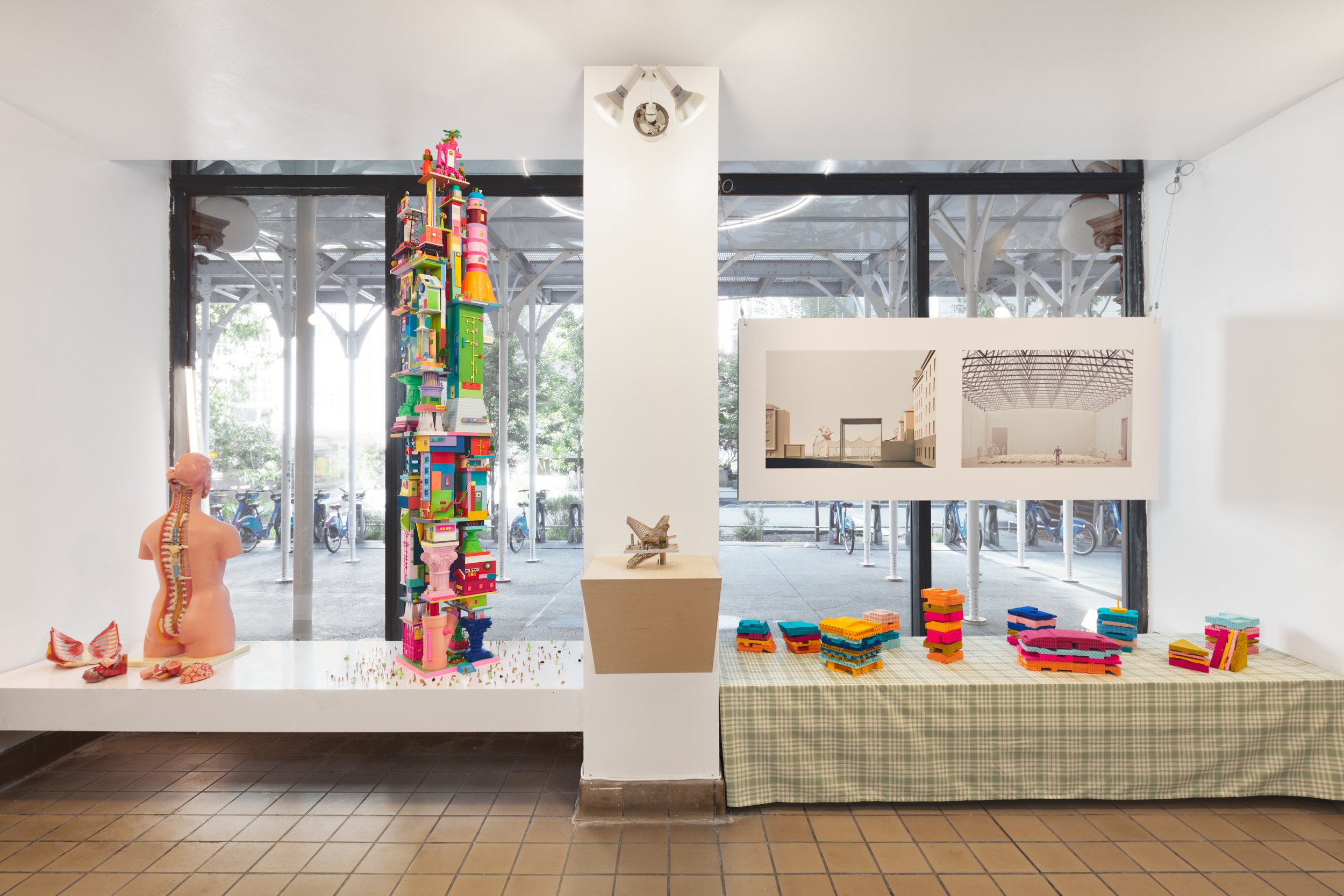
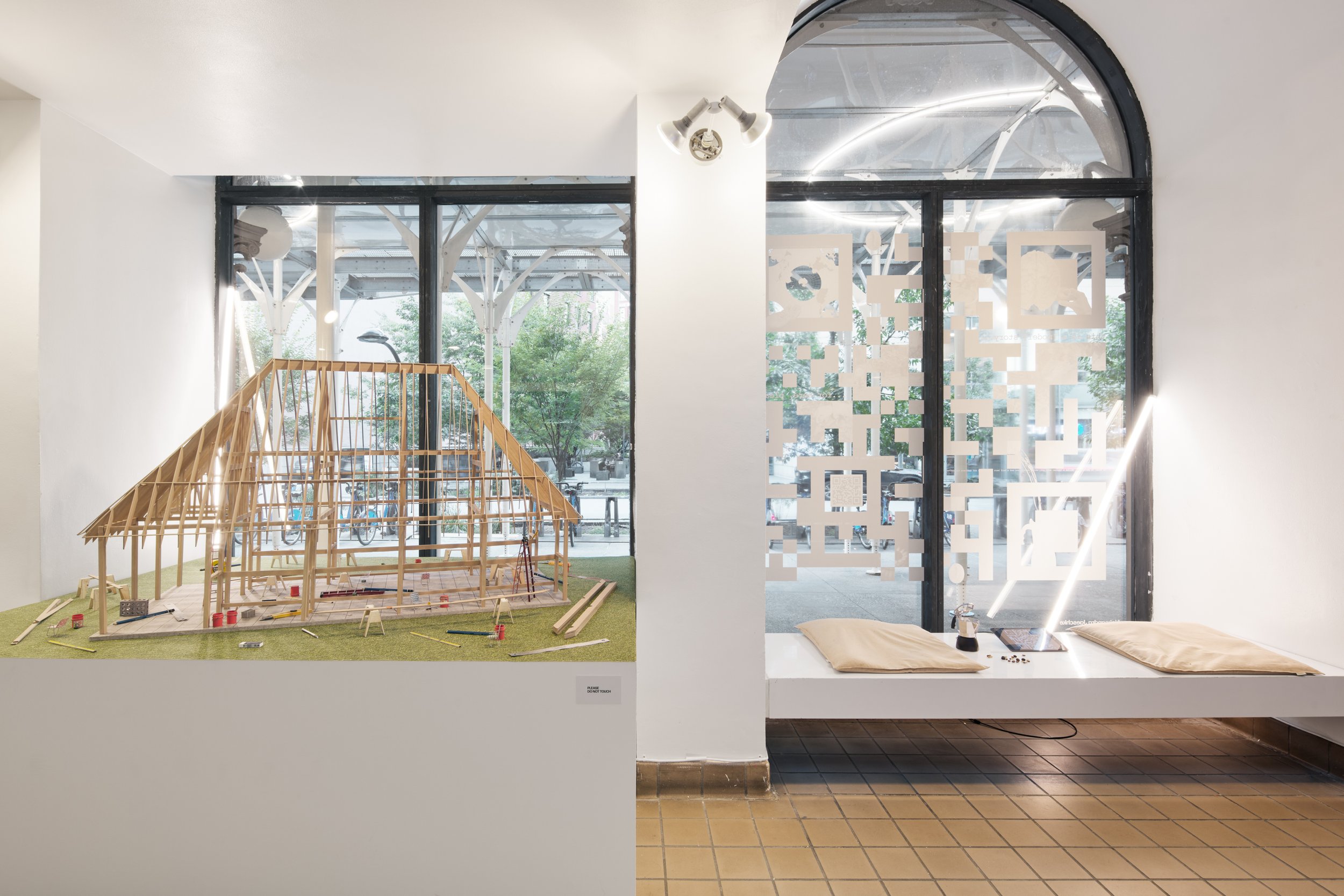

Model Behavior
October 4 – November 18, 2022
A group exhibition Curated by the Anyone Corporation and presented by The Irwin S. Chanin School of Architecture of The Cooper Union for the Advancement of Science and Art.
Models, whether physical or digital, are intrinsic to architecture. Just as science, mathematics, politics, economics, and other fields use models to visualize, reflect, and predict behaviors, so do architectural models. “Model Behavior,” a group exhibition curated by Log editor Cynthia Davidson, designed by New Affiliates (Ivi Diamantopoulou and Jaffer Kolb), considered how architectural models contribute to shaping social behaviors. Model Behavior featured 70 works and objects by 45 artists and architects including artists Olafur Eliasson, Isamu Noguchi, Ekow Nimako, and Thomas Demand, and architects Peter Eisenman, Darell Wayne Fields, Greg Lynn, Forensic Architects (Eyal Weizman), First Office (Anna Neimark and Andrew Atwood), MALL (Jennifer Bonner), Ensamble (Débora Mesa and Antón García-Abril), and Höweler and Yoon (Eric Höweler and Meejin Yoon).

Log 55
Summer 2022
From a bridge to blockchain, Amazonian urbanism to artificial intelligence, Log 55 (Summer 2022) recognizes the vast concerns of architecture today. This 176-page open issue, which includes a 16-page color insert, compiles essays, building and exhibition reviews, and remarks by 25 architects, theorists, and artists from around the world. In Berlin, Tim Altenhof critiques the newly rebuilt Humboldt Forum; in Los Angeles, Victor J. Jones reviews Michael Maltzan’s Ribbon of Light Viaduct; in New York, Cynthia Davidson visits the late Virgil Abloh’s “social sculpture,” and Thomas de Monchaux views “Anthony Ames Fifty Paintings”; in Quito, Ana María Durán Calisto and Sanford Kwinter draw inspiration from Indigenous territorial intelligence; in Rotterdam, Christophe Van Gerrewey reflects on MVRDV’s Boijmans Depot; in Taipei, Kwang-Yu King compares two new cultural venues by OMA and RUR; and in Tokyo, Jan Vranoský pens a postmortem for Kisho Kurokawa’s Nakagin Capsule Tower. Matthew Allen looks to computer science for a way out of the theory-practice divide; Simone Brott considers the ways NFTs will change architectural practice; Karel Klein draws parallels between memory and AI; and Marija Marič warns against digitized real estate fractions.
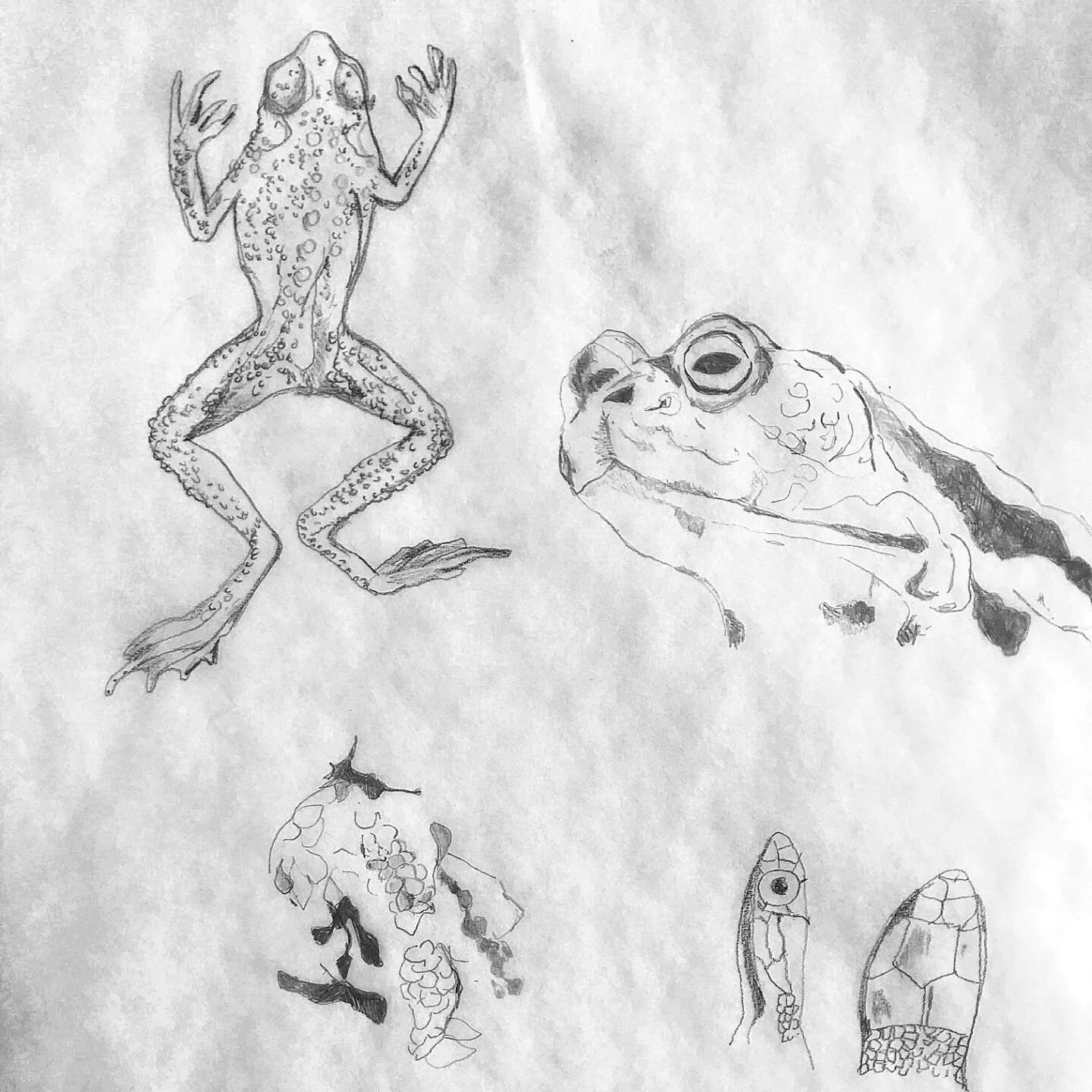
In addition, a special section guest edited by Francesco Marullo is devoted to Notes on the Desert. The section, which raises issues of climate change and the extraction economy, includes essays by architect Nathan Friedman on the US-Mexico border, artist Kim Stringfellow on jackrabbit homesteads, feminist scholar Traci Brynne Voyles on the 49ers, and architect Lydia Xynogala speaking for a desert toad; photo essays by the Center for Land Use Interpretation on nuclear tombs and by photographer Susan Lipper on desert utopia; as well as an interview with photographer Richard Misrach on his Cantos series.


@log_grams

LOG 54: Coauthoring
Winter/Spring 2022
Log 54: Coauthoring gathers essays by and conversations with architects, curators, historians, and collectives that, as guest editors Ana Miljački and Ann Lui write, begin to “imagine the field of architecture orienting around coauthoring instead of authoring” and “challenge the model of architectural authorship that dominates both architectural discourse and the market.” In so doing, the contributors to this 176-page thematic issue “enter the space of political and identity negotiations to relinquish absolutes and to open up to multiple forms of agency.” These forms of agency manifest in numerous ways, from the Fluxus Manifesto to the words of an Enlightenment painter, from bats to spider webs, from cartography to geological deep time, from AI-generated toys to PowerPoint and Miro boards.
Miljački and Lui talk with Jennifer Newsom and Tom Carruthers from Dream the Combine; J. Yolande Daniels and Amanda Williams from the Black Reconstruction Collective; architect and curator Andrés Jaque, and 2021 Chicago Architecture Biennial curator David Brown about their collaborative practices. Sumayya Vally and Moad Musbahi transcribe site-specific music, while Curtis Roth uses gig workers’ gestures to create paintings. The Architecture Lobby and Dark Matter University discuss the implications of coauthorship through their cowritten dialogues; Timothy Hyde and Lisa Haber-Thomson study Welsh building codes; Sarah Hirschman looks at US copyright law; and De Peter Yi and Laura Marie Peterson document how residents use the Detroit Land Bank. Historians Anna Bokov, S.E. Eisterer, and Michael Kubo recount coauthorship in Soviet education, resistance in gestapo prisons, and today’s anonymous architectural megacorporation.

LOG 53: Why Italy Now?
Fall 2021
Log 53 asks the simple yet provocative question “Why Italy Now?” The responses are as diverse and multifaceted as the country itself. Exploring this seemingly well-trod ground, one discovers that because of its historic centrality – and its precarity – Italy remains relevant to the challenges facing architecture today. As contributor Giulia Amoresano writes: “Amid calls today to challenge the Eurocentrism of canonical histories of architecture’s modernity and to work on decolonizing its theories and practices, work needs to be done on what we think canonical spaces are.”
Log 53 is guest edited by Alicia Imperiale in New York and Manuel Orazi in Macerata. Essays include philosopher Giorgio Agamben on a Venetian door, theorist Mario Carpo on blight in Piedmont, architect ElDante’ Winston on violence in Bologna, historian Edward Eigen on the Club of Rome, architect Fabrizio Furiassi on the Mafia in Sicily, and reporter Mario Calvo-Platero on colonial architecture in Tripoli. Emilia Giorgi explores unplanned greenery in Rome, while Gabriele Mastrigli highlights the planned greenery of EUR. Iwan Strauven reviews books on Carlo Aymonino and Aldo Rossi, Britt Eversole parses the trove of untranslated Italian theory, and Ingrid D. Rowland details her translation of Vitruvius. Paulette Singley sets the place for Italian cuisine, and Giulia Amoresano sources caffè espresso in the colonization of southern Italy. An Tairan revisits an 18th-century earthquake, Daniele Profeta analyzes the impact of the 19th-century Grand Tour, and Davide Spina exposes the dark side of postwar architecture culture. Greg Lynn talks with art historian Marilyn Aronberg Lavin about her digital analysis of Piero della Francesca, and Patrick Templeton asks writer and podcaster Alex Hochuli about Italy’s political legacy. Log 53 also presents projects by women building in Italy today – Lina Malfona, Elisabetta Terragni, and Maria Alessandra Segantini – as well as in the past – overlooked Neapolitan modernist Stefania Filo Speziale.
Graphic designer Ben Fehrman-Lee’s new design for the Writing Architecture Series books debuts with Formulations: Architecture, Mathematics, Culture, by Andrew Witt.
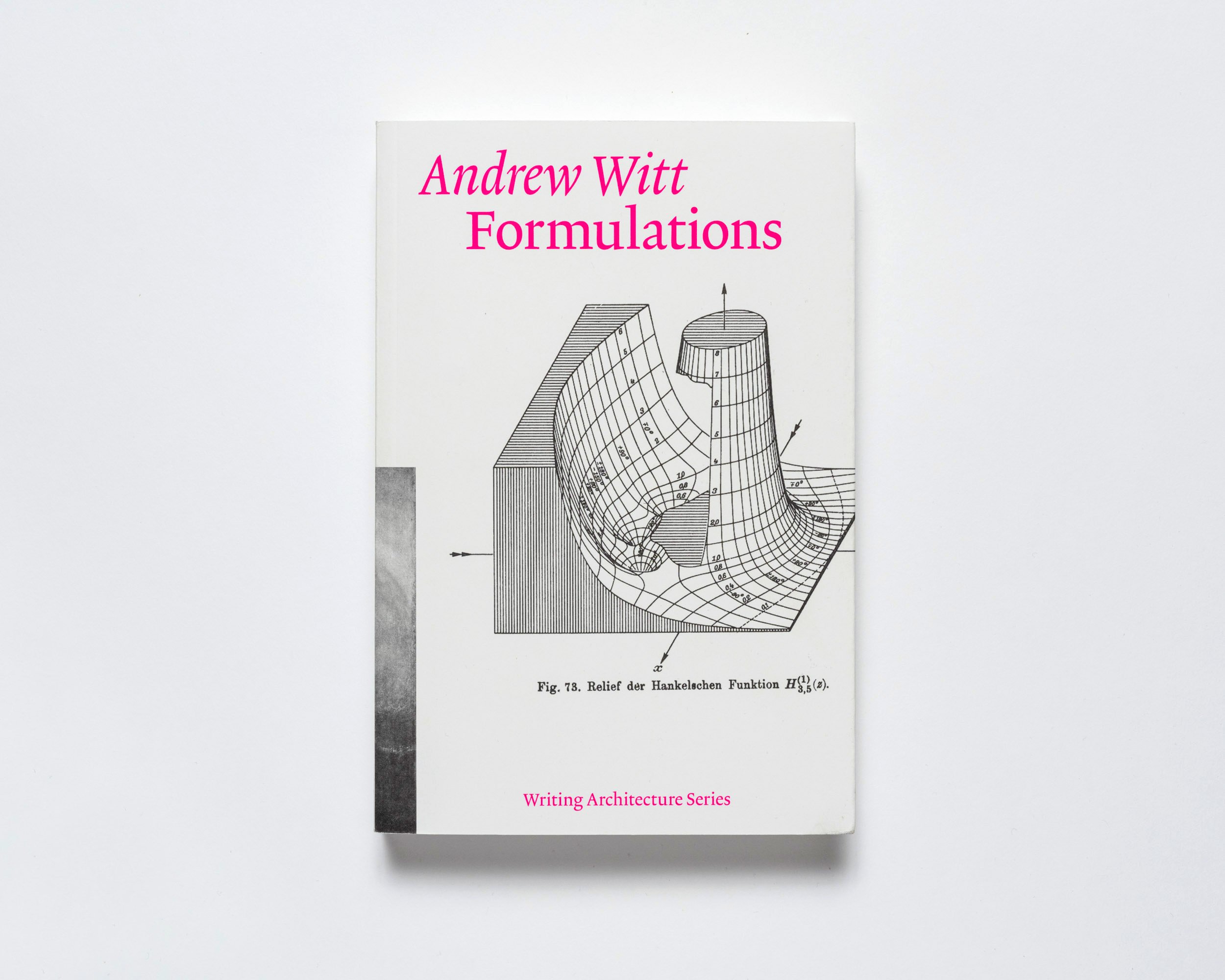
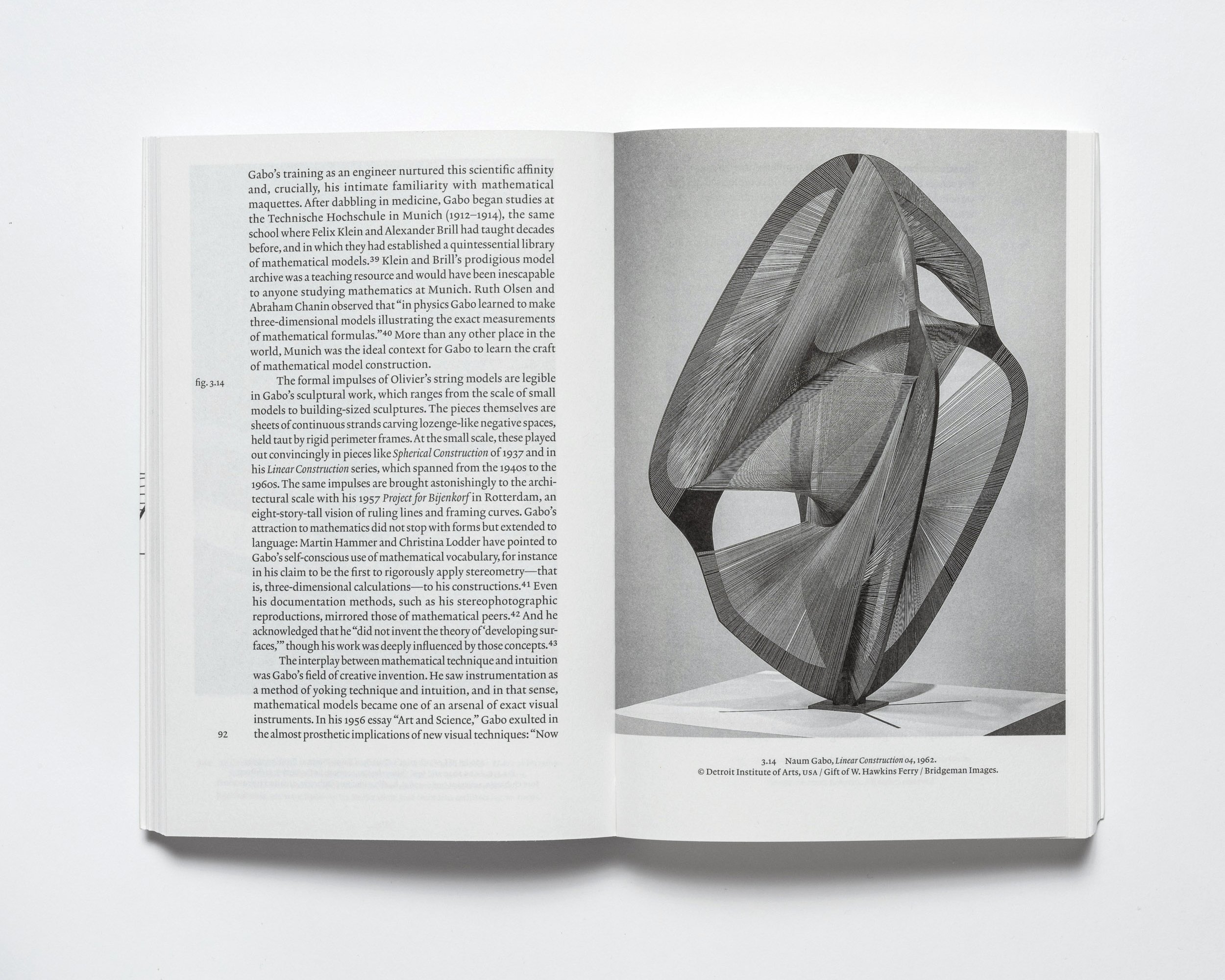
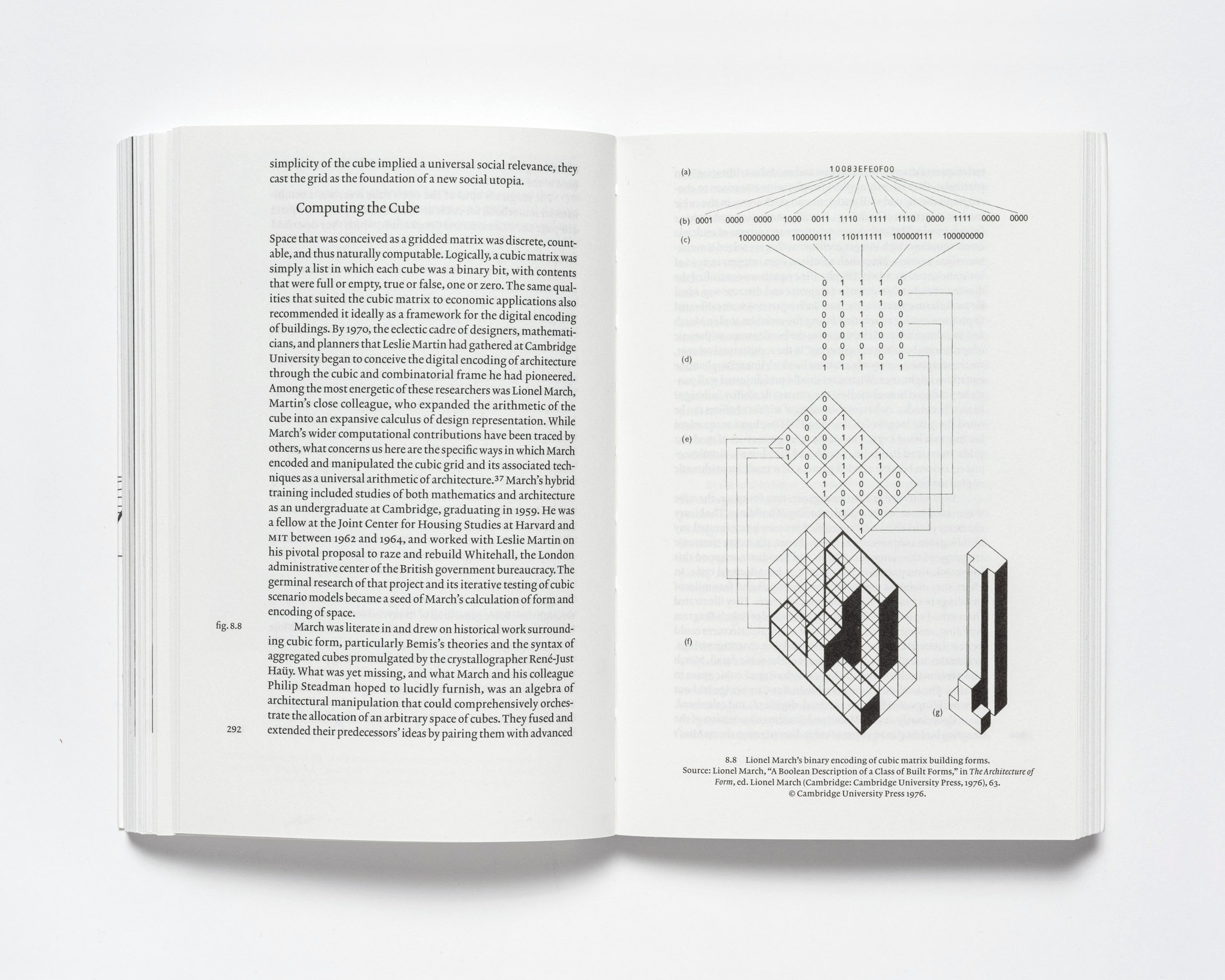
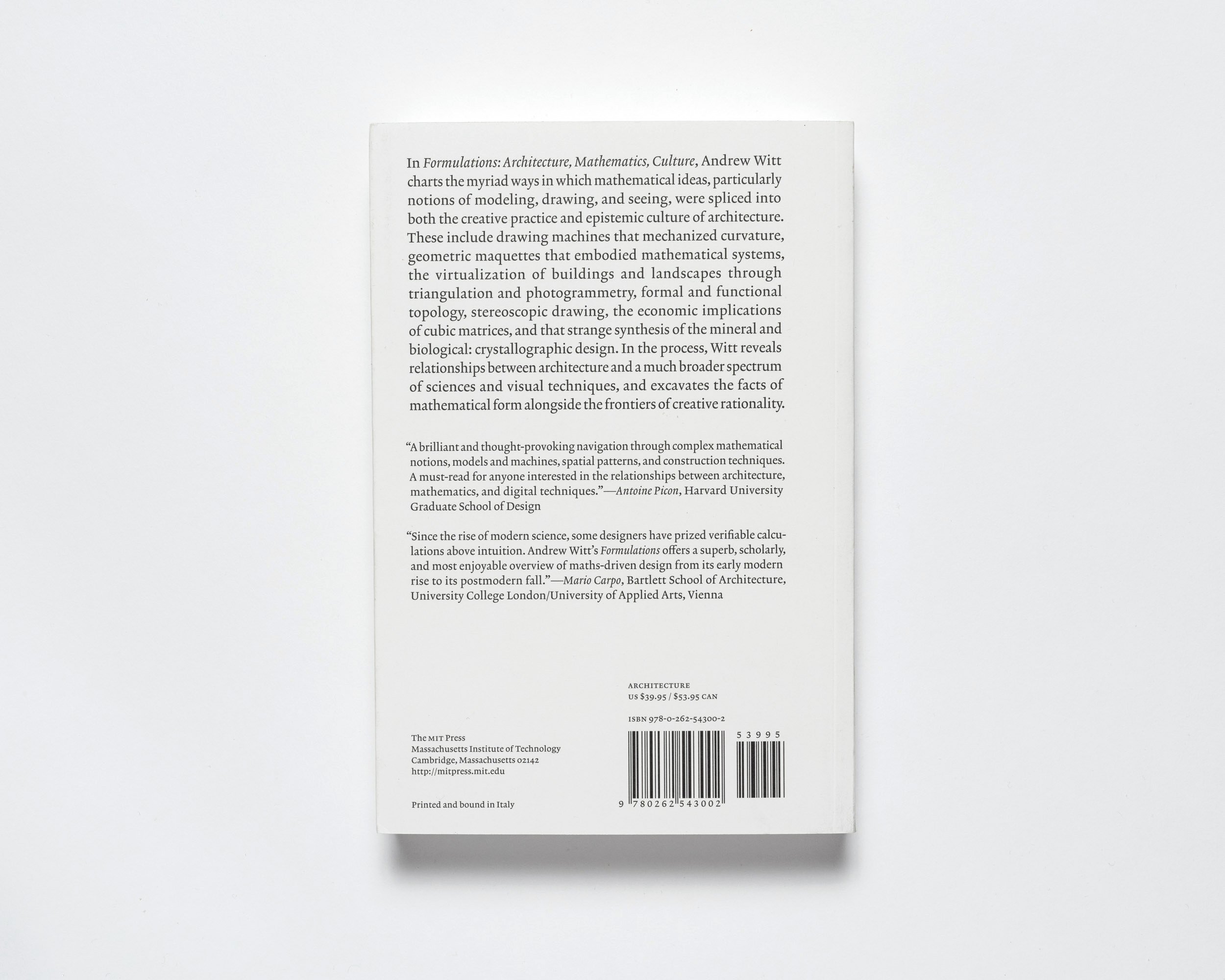
Formulations: Architecture, Mathematics, Culture
By Andrew Witt
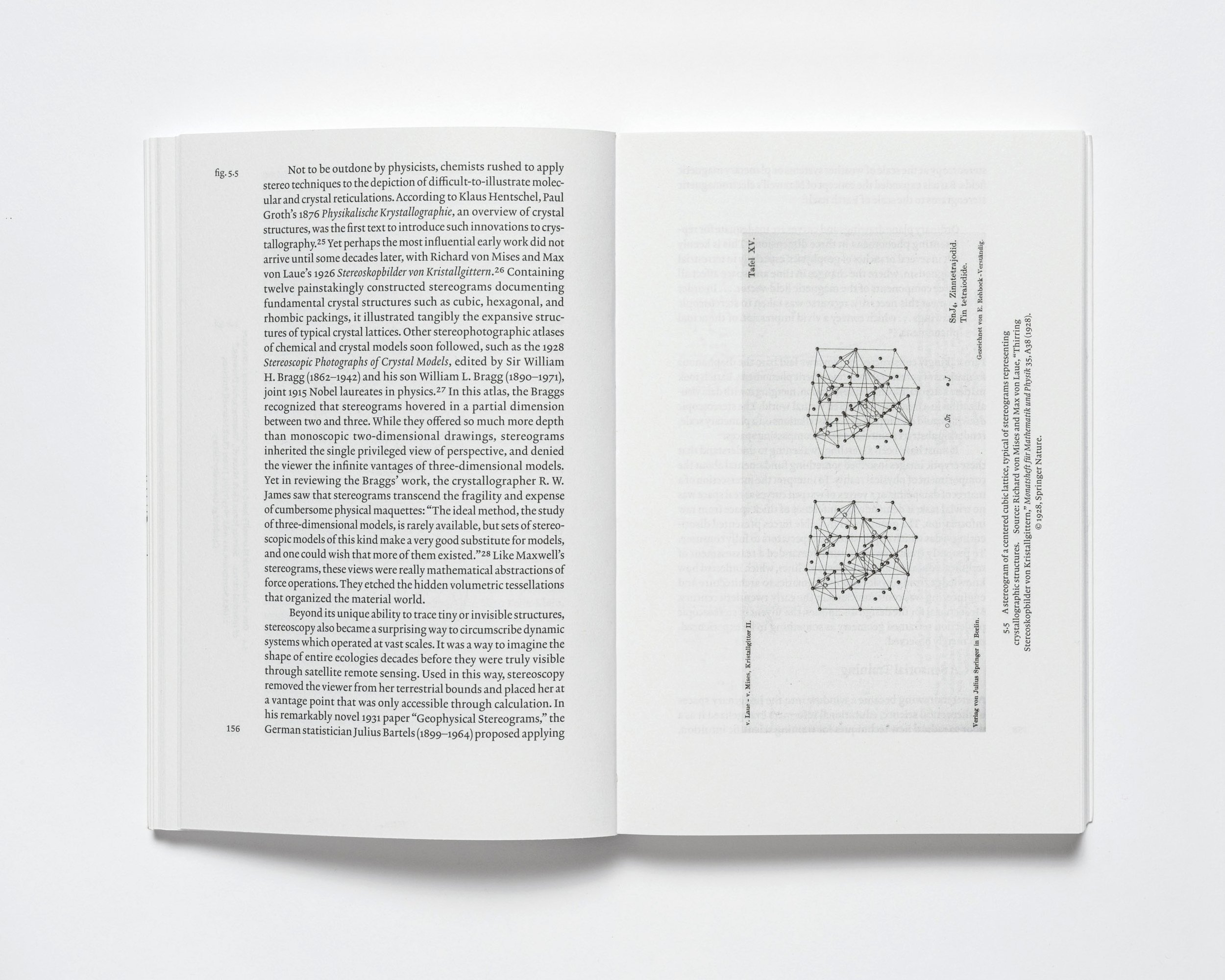
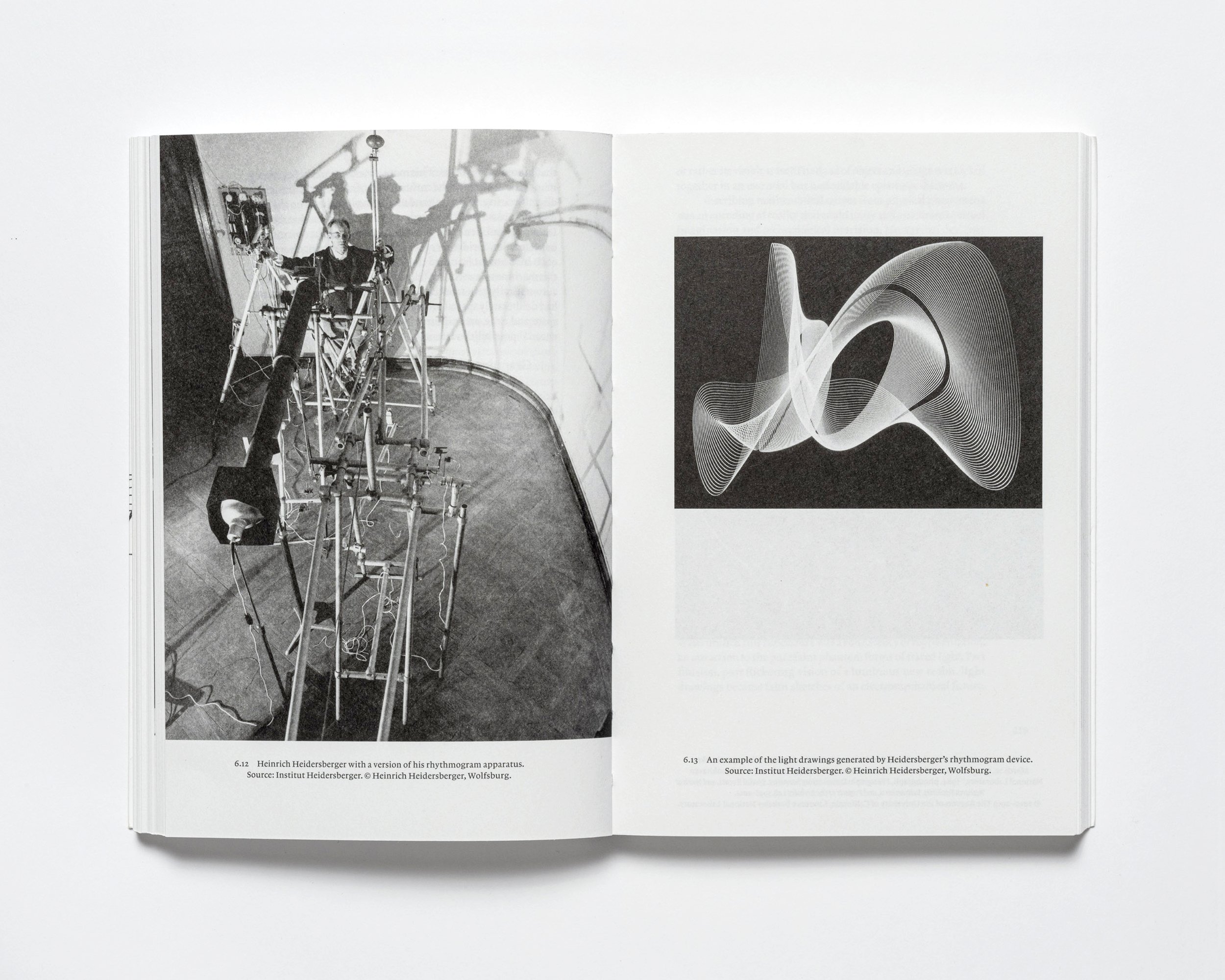
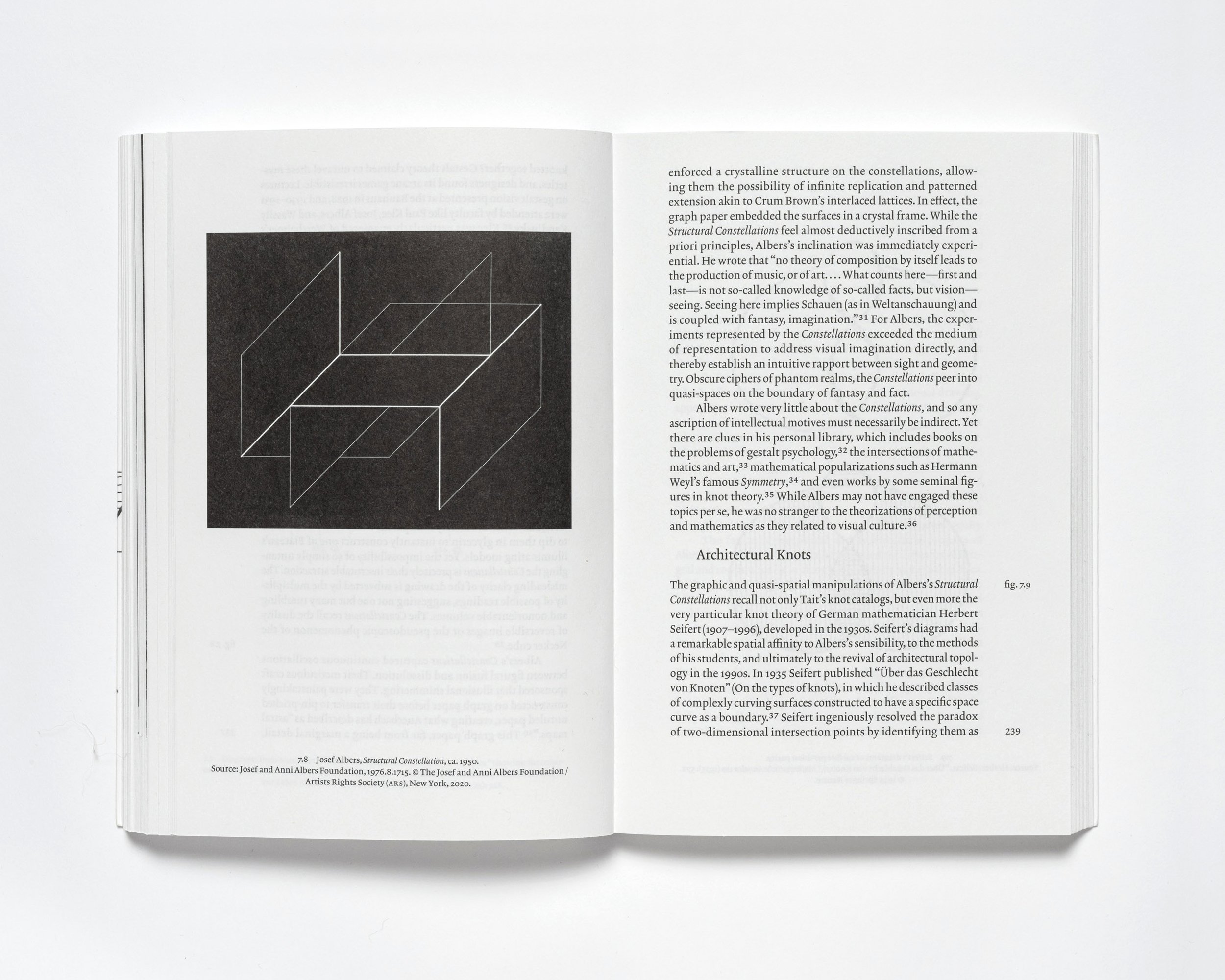
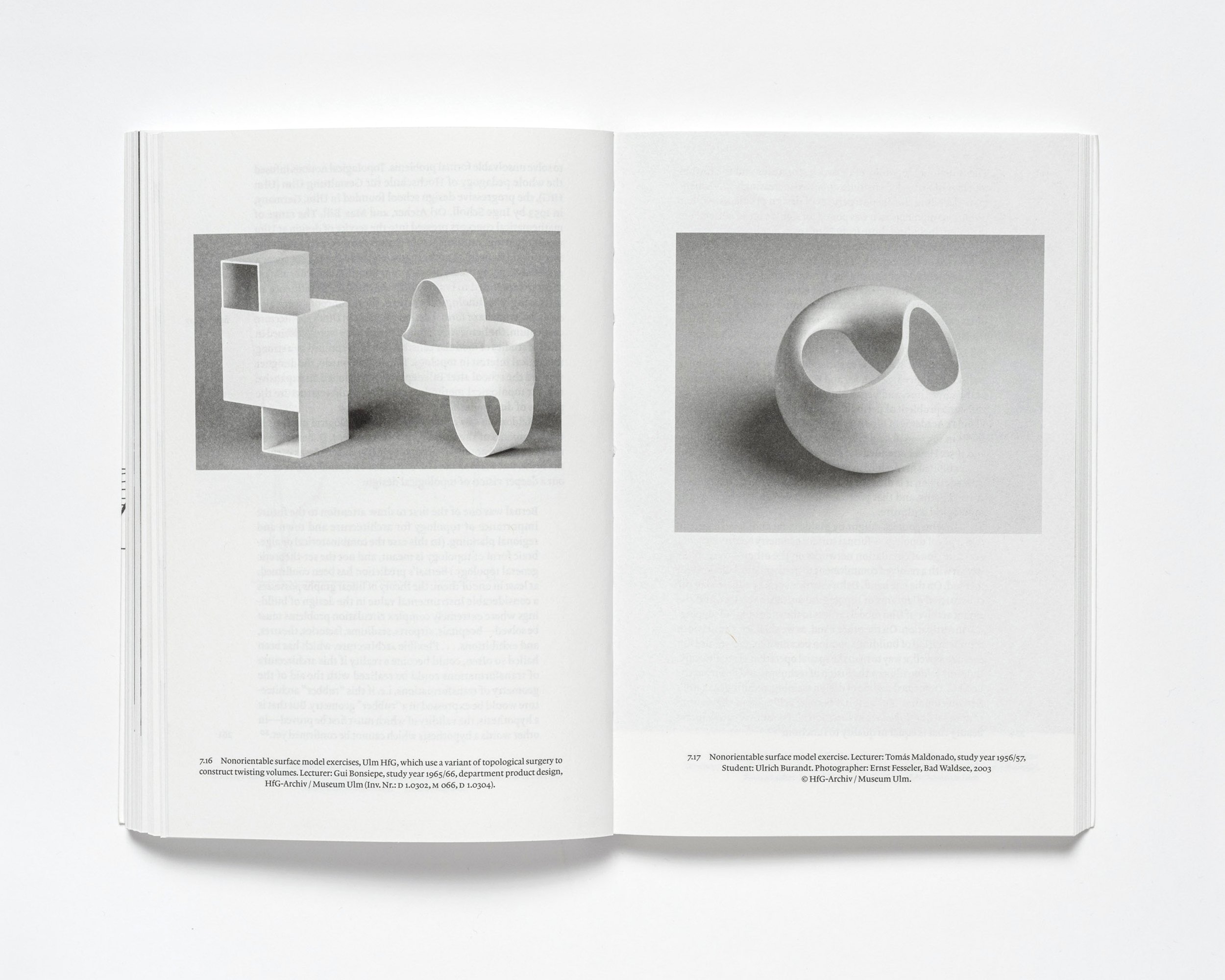
In Formulations, Witt examines the visual, methodological, and cultural intersections between architecture and mathematics. The linkages he explores involve architecture's encounters with a range of calculational systems — techniques that architects inventively retooled for design. Witt offers a catalogue of mid-20th-century practices of mathematical drawing and calculation in design that preceded and anticipated digitization as well as an account of the formal compendia that became a cultural currency shared between modern mathematicians and modern architects.
Extensively illustrated “biographies of method” chart the ways that mathematical notions of modeling and drawing were spliced into the creative practice of design. These include early drawing machines, the virtualization of buildings and landscapes through surveyed triangulation and photogrammetry, formal and functional topology, the economic implications of cubic matrices, and a strange synthesis of the technological, mineral, and biological: crystallographic design.
Through an intercultural exchange with other disciplines, Witt argues that architecture adapted not only the shapes and surfaces of mathematics but also its values and epistemic ideals.

Confronting Carbon Form
five conversations on energy, power, space, and architecture.
Climate breakdown demands new ways of building, designing, and living together, yet architecture continues to work within the logic of carbon modernity. Confronting Carbon Form is an event series curated by Stanley Cho, Elisa Iturbe, and Alican Taylan that builds on the themes of Log 47: Overcoming Carbon Form. The series brings together architects, historians, theorists, and scholars to confront the spatial expression of our fossil fuel paradigm – carbon form – in order to find a new way forward.
Calendar of Events:
10.06.21: The Confrontation
10.27.21: The City
11.11.21: The Suburb
12.01.21: The Building
01.15.22: The Unknown
Log'rithms
Five exponential conversations in architecture
Five months, five events via the Italian Virtual Pavilion, always on a Thursday:
Calendar of Events:
06.17.21: Excursions in the Ecosphere
07.15.21: The Science of Architecture
08.19.21: Reorigination
09.16.21: Model Behavior
10.21.21: Overcoming Carbon Form

LOG 52
Summer 2021
Through essays, conversations, and reviews, the architects, artists, journalists, and theorists gathered in Log 52 interrogate architecture’s role in a world of social, virological, environmental, and paradigmatic change. As David Adjaye says in a conversation with curator Thelma Golden and artist Rick Lowe about Black social practice, the work to be done today “is a planetary project that’s about understanding a world filled with a multitude of peoples and perspectives.”
The multiple perspectives in Log 52 include: Vickii Howell, Joycelyn Davis, Darron Patterson, and Joe Womack on the past, present, and future of Africatown in Mobile, Alabama; Deborah Gans on diverse and resilient communities in New Orleans; and Charles L. Davis II on the exhibition “Reconstructions: Architecture and Blackness in America.” Fonna Forman and Teddy Cruz remember the late Michael Sorkin and his prescient warnings about the neoliberal city; Matthew Soules looks at housing as a financial asset of global capitalism; and Patrick Templeton evaluates Thomas Heatherwick’s spectacle urbanism. In a series of book and exhibition reviews, Kurt W. Forster travels from the Gothic to the digital in Lars Spuybroek’s Grace and Gravity; Kyle Miller finds unlikely resonances among architects in David Erdman’s Introducing; Thomas de Monchaux follows constructive lines in Studio Ames’s “Linee Occulte”; and Whitney Moon sees double in BlairBalliet’s “No More Room.” In addition, Cynthia Davidson interviews Emilio Ambasz, often called the father of green architecture, and Lindy Roy and Leah Kelly study our nervous system’s mapping capacities.
Log 52 concludes with Cosmodality, the third guest-edited nature section, which features essays by Sanford Kwinter on VR, Ed Keller on cosmopolitics, and a discussion between guest editor Gökhan Kodalak and philosopher Elizabeth Grosz.

Now Available: Log Bookends
Designed and hand fabricated in Brooklyn by Leopoldo Villardi, these hickory branch bookends are richly textured yet minimal. Each measures 4 1/2 by 2 3/4 by 8 1/4 inches and weighs 3 pounds. They are made of durable Hydrocal® White Gypsum Cement, sealed with matte lacquer, and are set on silicone feet. Log bookends are made on-demand and ship within 8 weeks of purchase.
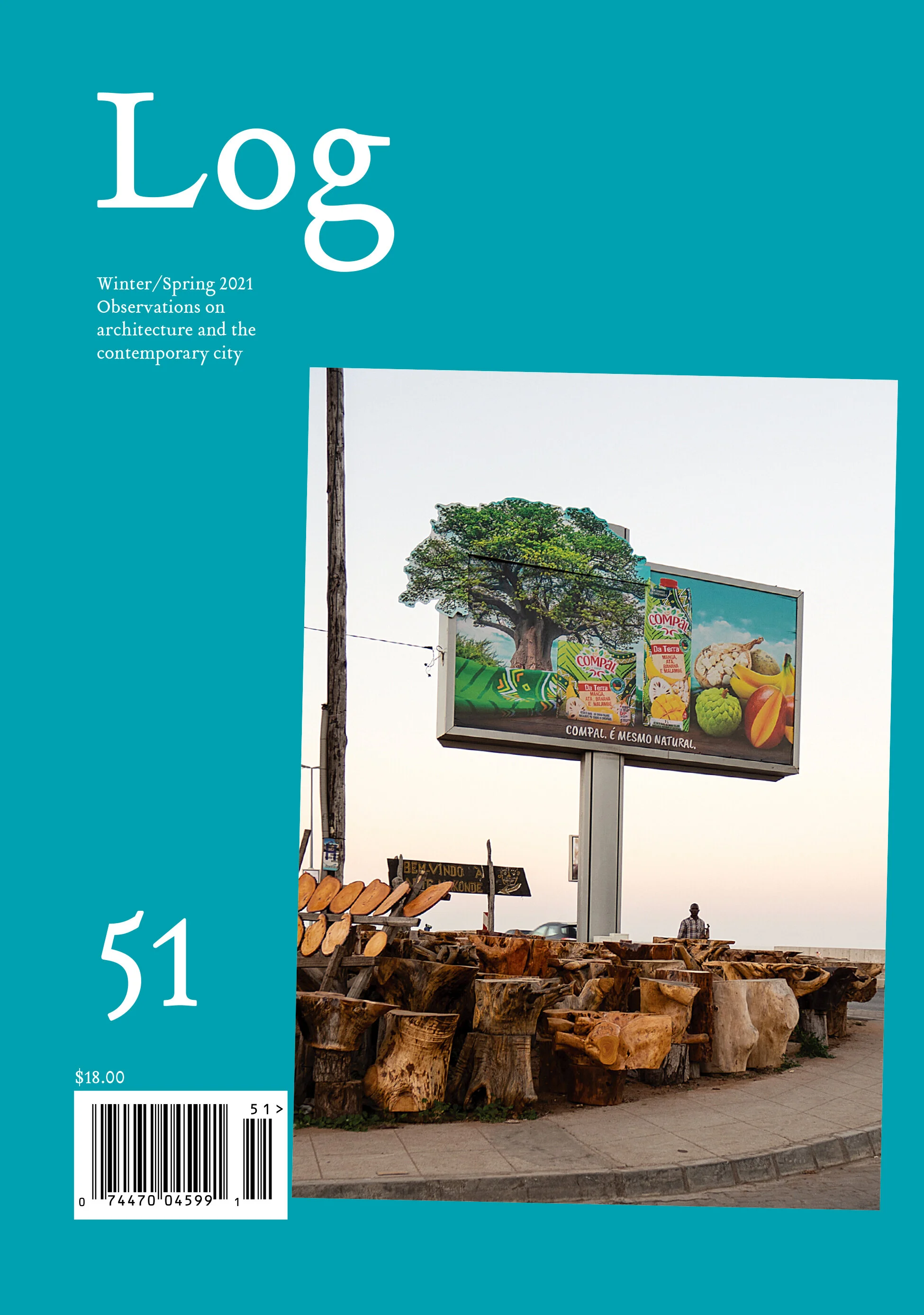
LOG 51
Winter/Spring 2021
From New Delhi to Nanjing, Tohoku to Tulsa, Maputo to Mito, Log 51 (Winter/Spring 2021) gathers essays and observations from architects, historians, designers, and curators around the world on topics that range from the potential of images and architectural representation to the power of art and politics. In this open issue, Carrie Norman and Thomas Kelley reimagine the early work of Bruce Goff, Christophe Van Gerrewey assesses Jan De Vylder’s sketches and Excel drawings, and Thomas Daniell explores Sei’ichi Shirai’s unbuilt atomic memorial. Dijia Chen follows how a single photograph shaped the career of Zhang Lei, and Ruo Jia defines post-Maoist architecture in China. Max Kuo maps postdigital/postinternet architecture, Iman Fayyad sees flatness as a productive framework, and Kyle Miller unpacks a deadpan tonality. In addition, Harish Krishnamoorthy questions India’s new government district, while Courtney Richeson digs into the alt-right foundations of the 2020 US Federal Civic Architecture mandate. Véronique Patteeuw and Clara Leverd visit a collector’s London flat, Tatiana Knoroz discovers ingenuity in Japanese danchi, and much more. . . .
One-quarter of the 200-page issue is devoted to Excursions in the Ecosphere, the sequel to The Return of Nature in Log 49. In this special section guest edited by Sanford Kwinter, Aleksandra Jaeschke synthesizes systems theory, greenhouse architecture, and banyan trees, Gökhan Kodalak plays with lines of forces in a David Foster Wallace memoir, and Kwinter and Bruce Mau discuss shifting paradigms of design.
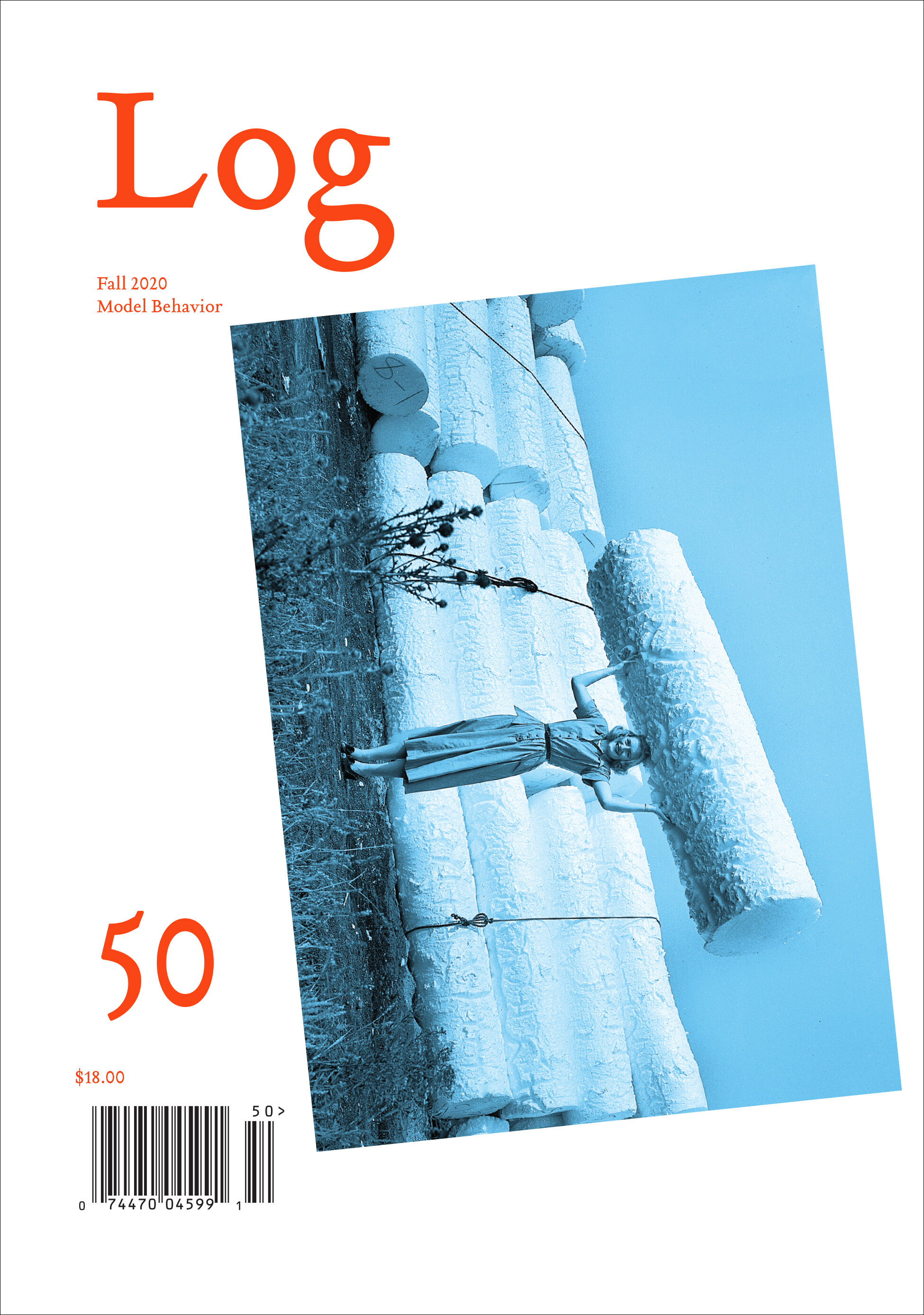
LOG 50: Model Behavior
Fall 2020
From the economic to the political, from public health to the climate, models seem to run the world. In architecture, the model is no longer just a physical tool for conceptualizing or representing architects’ visions but must also encompass digital and 3D-printed models, data and artificial intelligence models, business models, educational models, and even engage the discipline’s own questionable history in establishing role models. A thematic issue, Log 50: Model Behavior interrogates models in this expanded sense: what are their values, their behaviors, and the behaviors they elicit. In a record-setting 256 pages, 39 authors, ranging from established architectural thinkers to up-and-coming practitioners, examine the role of the model in architecture today through critical essays, conversations, observations, projects, and provocations.

LOG 49
summer 2020
As the world reckons with the compounding crises of a pandemic, racial unrest, a recession, and climate change, Log 49 compiles essays, interviews, observations, and manifestos by 29 authors in an effort to make sense of architecture, the city, and nature in the midst of turmoil. This 196-page issue includes a special section, The Return of Nature, guest edited by architectural philosophers Gökhan Kodalak and Sanford Kwinter, who write in their introduction, “The world is on fire, and we are the fire. . . . The time has come for a reboot.” They, along with philosophers Muriel Combes and Erin Manning and architects Jenny E. Sabin and Peter Trummer, offer concepts and methods toward that reboot.
Aspects of nature permeate the entire issue. Historian Sylvia Lavin explores architects’ depictions and use of trees in four essays seeded throughout the issue and philosopher Jacques Rancière discusses the aesthetic regime of 18th-century landscape, while architect Sasa Zivkovic unravels the structural potential of unusable trees and Erin and Ian Besler produce an interactive pop-up postcard for practicing tree pruning. Architects Neeraj Bhatia and Emmett Zeifman each rethink the idea of collective form, Elena Manferdini and Christina Griggs see new possibilities in color, and Luke Studebaker digs deep into the AMO/Rem Koolhaas exhibition “Countryside, The Future.” In response to the COVID-19 quarantine, philosopher Emanuele Coccia calls for a domestic revolution, Henryetta Duerschlag learns to teach photography via Zoom, and architecture students observe New York City in lockdown from their windows. And in a recollection that is broadly relevant today, when the ground seems to be shifting beneath our feet, historian Nakatani Norihito recounts how when viewing the devastation wrought by the 3/11 earthquake and tsunami in Japan, he realized that “without land, architecture and architecture history are meaningless.”

LOG 48: Expanding modes of practice
winter/spring 2020
“The center of architecture is shifting and cannot hold,” writes guest editor Bryony Roberts in Log 48: Expanding Modes of Practice. This moment of change, in which issues of inequity and intersectionality are coming to the fore, represents “an invitation to think differently, a chance to reask the questions that haunted the 20th century.”
The collected authors in this issue range from architects and urbanists to curators and composers who grapple with what it means to practice in a more just way, balancing aesthetics with ethics. As Roberts writes, “What emerges from [these] experiments with situated, intersectional practice is the merging of the professional and the personal. Rather than neutrality, practices cultivate empathy.” At the heart of this issue are Roberts’s interviews with progressive practices Assemble, Borderless Studio, HECTOR, LA-Más, and Mabel O. Wilson. In addition, essayists Peggy Deamer and Michael Kubo discuss collaborative architecture practices today and in the past; Ann Lui advocates for an Office of the Public Architect; Jane Rendell and Margo Handwerker define what it means for work to be situated and specific; Ana Miljački and Jerome Haferd propose better pedagogies; and Jia Yi Gu, Deborah Garcia, and the feminist architecture collaborative position feminist theory in architectural practice and discourse today. Also in this issue, Katy Barkan and Ashley Fure contextualize their installation works; Jess Myers expands the idea of kinship; Mira Henry and John Cooper discuss a “not-famous” building in Los Angeles; and Cynthia Davidson talks with Mirko Zardini about the role of the museum today.


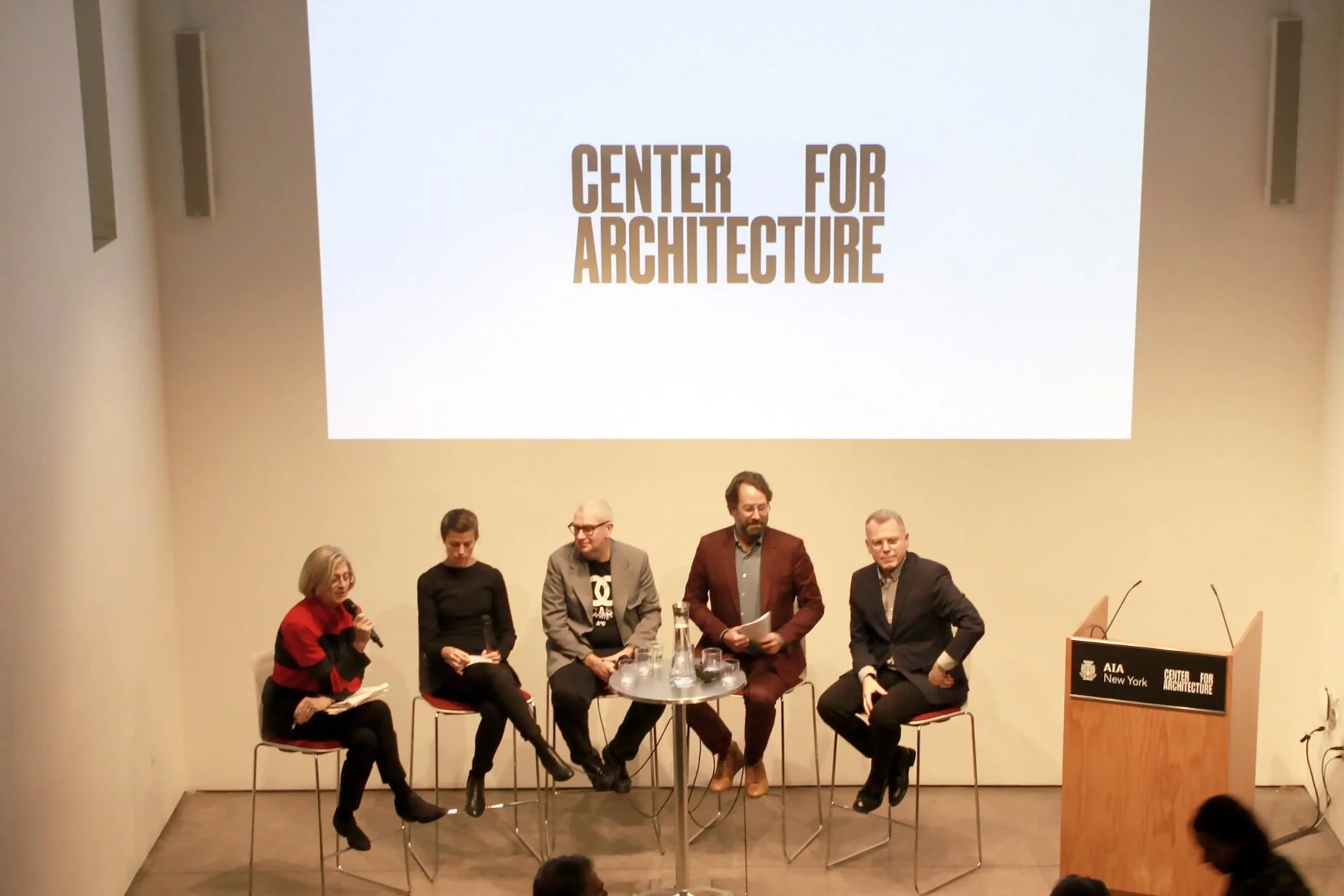
LAUNCH OF LOG 47: OVERCOMING CARBON FORM
NOVEMBER 19, 2019
More than 120 people gathered at the Center for Architecture in New York to toast the launch of Log 47: Overcoming Carbon Form, an important thematic issue that reframes architecture’s role in addressing climate change. Guest editor and author Elisa Iturbe (Yale and Cooper Union) and authors Daniel A. Barber (University of Pennsylvania), Michael Bell (Columbia University), and Douglas Spencer (Iowa State University) delivered brief presentations based on their essays and participated in a roundtable conversation and Q and A moderated by editor Cynthia Davidson. The discussion ranged from definitions of carbon form to the human desire for comfort, the potential for solar energy to disrupt the debt-based economy, and neoliberalism’s lack of imagination – all subjects that elicited lively audience participation. The issue is sold out, but a video of the launch is still available through the Center for Architecture’s Vimeo.

LOG 47: Overcoming carbon form
fall 2019
“Until now, most environmental discourse in architecture has focused on carbon as a by-product of building and construction,” writes guest editor Elisa Iturbe in Log 47, “making it seem that at the ecological brink, architecture’s most pressing concern is energy efficiency.”
“Overcoming Carbon Form,” Log’s 200-page thematic Fall issue, reconceives architecture's role in climate change, away from sustainability and solutionism and toward architecture's formal complicity and potential agency in addressing the climate crisis. As Iturbe writes, “Decarbonization is not solely a question of technology and buildings systems but also a theoretical question for architecture and the city, one that questions carbon modernity as an obsolete cultural and material foundation for architecture.” To that end, the 24 authors – architects, artists, sociologists, historians, novelists, and policy makers – approach architecture’s role in the climate crisis in widely varied ways. From Pier Vittorio Aureli and Maria Shéhérazade Giudici on rethinking private property to Michael Bell and Eunjeong Seong on the house as power plant; from Holly Jean Buck on carbon sequestration infrastructure to Mimi Sheller on the military-infrastructural complex; from Skender Luarasi on anticipation to Albert Pope on urban obsolescence; from Lizzie Yarina on neoliberal resilience schemes and Gökçe Günel on a status quo utopia to Tahl Kaminer on the impossibility of autarky and Douglas Spencer on the fantasy of island life. Also in this issue, Kiel Moe on new perspectives, Rania Ghosn on geographic externalities, Laurence Lumley on asphalt, Ingrid Halland on plastic, Greg Lindquist on rolling coal, and Daniel A. Barber on air-conditioning. Plus an excerpt from Amitav Ghosh’s book The Great Derangement and a conversation with Rhiana Gunn-Wright about the Green New Deal.


15 years of Log
December 3, 2018
Log 44 (Fall 2018) marks 15 years since Log 1 rolled off the presses in September 2003. We celebrated the dynamic longevity of this important platform for critical thinking and the exchange of ideas about architecture and the city at the Center for Architecture in NYC on December 3, 2018. Editor Cynthia Davidson led a discussion with architects and former Log guest editors Mark Foster Gage, Bryony Roberts, and Cameron Wu about the state of architectural discourse, and Savinien Caracostea, guest editor of Log 34: The Food Issue, sliced up a six-foot-long Log confection.

On Accident: Episodes in Architecture And Landscape
by Edward Eigen
The Writing Architecture series is pleased to announce a new book, On Accident, a collection of writings by Edward Eigen, “architectural history’s most beguiling essayist” (as Reinhold Martin calls him in the book’s foreword). Eigen illuminates the unfamiliar, the arcane, and the obscure – phenomena largely missing from architectural and landscape history. His essays do not walk in a straight line but wander across uncertain territories, discovering sunken forests, unclassifiable islands, inflammable skies, unvisited shores, and plagiarized tabernacles. Gleaning new insights from Foucault, Hamlet, Olmsted, the High Line, and London’s Houses of Parliament, among a wealth of other things, Eigen compares his work to the “gathering up of seeds that fell by the wayside.” The seedlings create in the reader’s imagination a dazzling display of the particular, the contingent, the incidental, and the singular, all in search of a narrative that Eigen provides. As one critic writes, “[Eigen’s] prose is bound to capture careful or casual readers.”

Anyspace, 59 Franklin Street, New York City

Anyspace pop-up shop, designed and installed by Almost Studio LLC.
DRAWINGS' CONCLUSIONS
Anyspace has opened its second year with “Drawings’ Conclusions: The Ends of the Line.” The exhibition of contemporary architectural drawings runs through March 3, in the Anyspace pop-up gallery at 59 Franklin Street in New York City. First seen at the SCI-Arc Gallery in Los Angeles, the show assembles 60 drawings by 13 architects, work that engages in the conceptual, technical, and sometimes personal potential of drawing during the time of architecture’s transition from hand drawing to digital representation. “Drawings’ Conclusions” was curated by Jeffrey Kipnis and produced by Andrew Zago and Laura Bouwman.
Click here for more information about the exhibition and architects’ gallery talks.

Anyspace presents
"This Future Has a Past"
July 25–September 12, 2017
Center for Architecture, New York
Anyspace will launch its exhibition program on Tuesday, July 25, 2017, with “This Future Has a Past,” created by Katherine Lambert and Christiane Robbins. “This Future Has a Past” presents a single work by the late California architect Gregory Ain – his Exhibition House for America's middle class, the second house to be built in the garden of the Museum of Modern Art, in 1950 – alongside documentation of his “un-American activities” collected during the McCarthy era. J. Edgar Hoover deemed Ain “the most dangerous architect in America.” The fate of Ain’s Exhibition House after the show closed is still unknown. Archival FBI files and MoMA press documents, a newly constructed model of the 1950 Exhibition House, and a series of lenticular images created by Lambert + Robbins call attention to this little-known bi-coastal architectural history.


The Architectural Imagination now at the A+D Architecture and Design Museum, Los Angeles
Through September 23, 2017
The Architectural Imagination, the exhibition of 12 speculative architectural projects curated by Cynthia Davidson and Mónica Ponce de León for the US Pavilion at the 2016 Venice Biennale International Architecture Exhibition, is now on view at the A+D Architecture and Design Museum, Los Angeles. Organized by the University of Michigan’s Taubman College of Architecture and Urban Planning and the Anyone Corporation, the show began in Venice, where it was seen by a record-breaking audience in the US Pavilion, and traveled to the Museum of Contemporary Art Detroit (seen here) this past spring.
For the Biennale, Davidson and Ponce de León challenged 12 visionary American architectural practices to imagine new programs and forms for four sites in Detroit, which they selected from the recommendations of an 11-member Detroit advisory group: the Packard Plant, a USPS sorting facility, the Dequindre Cut Greenway, and Mexicantown/Southwest Detroit.
The 12 architecture teams are: A(n) Office, Detroit; BairBalliet, Columbus, OH, and Chicago; Greg Lynn FORM, Los Angeles; Mack Scogin Merrill Elam Architects, Atlanta; Marshall Brown Projects, Chicago; MOS, New York; Pita & Bloom, Los Angeles; Present Future, Houston; Preston Scott Cohen Inc., Cambridge, MA; SAA/Stan Allen Architect, New York; T+E+A+M, Ann Arbor, MI; and Zago Architecture, Los Angeles.